
High Temperature Servo Motor Benefits and Applications?

High Temperature Servo Motors are increasingly critical in various industries. They offer distinct advantages in environments where traditional motors fail. These high-performance motors can operate efficiently in extreme heat. As a result, they ensure reliability and precision in demanding applications.

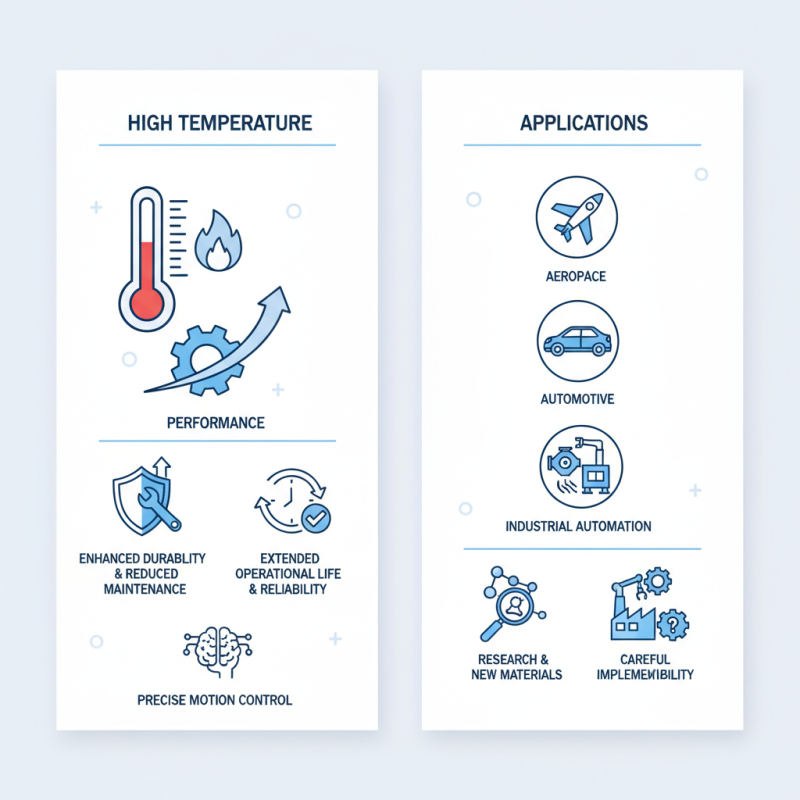
The benefits of High Temperature Servo Motors include enhanced durability and reduced maintenance needs. Their ability to withstand elevated temperatures promotes longevity in operational life. This reliability is essential for manufacturers looking to minimize downtime. Additionally, their capacity for precise motion control ensures high productivity.

In certain applications, such as aerospace or automotive, High Temperature Servo Motors demonstrate their importance. They play a pivotal role in systems that experience significant thermal stress. Understanding these motors allows industries to enhance performance effectively. However, ongoing research is needed to address limitations and explore new materials. Implementing these motors requires careful consideration of operating environments and compatibility.
High Temperature Servo Motor Benefits and Applications?

High Temperature Servo Motors: An Overview

High temperature servo motors are increasingly important in various industries, extending operational capabilities to extreme environments. These motors can operate effectively at temperatures exceeding 200°C, making them suitable for applications in aerospace, automotive, and manufacturing sectors. According to a recent industry report, the demand for such motors is expected to grow by over 25% annually through 2027, highlighting their rising significance.

One major application is in the aerospace industry. High temperature servo motors are crucial for controlling actuators in aircraft systems. These motors withstand high temperatures and maintain performance, ensuring safety and reliability. They also play a role in automotive applications, particularly in electric vehicles where motor efficiency at elevated temperatures is essential. In fact, a study by an engineering firm revealed that optimal motor performance at high temperatures can enhance energy efficiency by up to 30%.

Navigating the complexities of high temperature environments can be challenging. Material selection and design must be carefully considered. Not every motor can endure these conditions without significant risk of failure. Continued innovation is needed to address these limitations, ensuring that the motors not only function but also maintain longevity. The industry relies on ongoing research and data analysis to improve performance metrics and push the boundaries of what high temperature servo motors can achieve.

High Temperature Servo Motor Performance Comparison

This chart compares the performance characteristics of high temperature servo motors against standard servo motors, illustrating their advantages in high temperature applications.

Key Advantages of High Temperature Servo Motors

High temperature servo motors offer significant advantages in various industrial applications. These motors can operate efficiently in environments exceeding 100°C. This capability makes them essential in industries such as aerospace, automotive, and manufacturing. A report by the International Society of Automation highlighted that high temperature motors can maintain performance while reducing downtime. This leads to improved overall productivity.

One of the key benefits is their ability to withstand extreme conditions without failure. In studies, high temperature servo motors demonstrated a lesser degradation rate compared to standard models. This exceptional resilience translates to increased operational longevity. Also, they minimize heat-related failures that can lead to costly repairs. However, they may have limited availability in some regions.

Energy efficiency is another crucial factor. High temperature servo motors often consume less energy. The U.S. Department of Energy found that improved energy efficiency could reduce operational costs by up to 30%. This aspect is attractive for companies focused on sustainability. Despite these advantages, the initial investment can be higher. Businesses must weigh the long-term benefits against upfront costs.

High Temperature Servo Motor Benefits and Applications

Feature Description Applications
Wide Operating Temperature Range High temperature servo motors can operate effectively in extreme environments, often from -40°C to 200°C. Aerospace, military, and automotive applications.
Enhanced Durability Manufactured with materials that withstand high thermal stress, ensuring longevity and reliability. Industrial automation and robotics.
Improved Efficiency High temperature servo motors maintain performance without overheating, optimizing energy consumption. HVAC systems and energy generation setups.
Compact Design Allows integration in tight spaces while delivering high performance. Medical devices and compact machinery.
High Torque Output Delivers strong performance even under extreme conditions, suitable for demanding applications. Power transmission and heavy lifting equipment.

Common Applications in Various Industries

High temperature servo motors are crucial in many industries. They operate effectively in extreme environments, where traditional motors might fail. This quality makes them valuable in sectors like aerospace, automotive manufacturing, and robotics.

In aerospace, these motors cope with high heat during rocket launches. They ensure precision control of various components, like thrusters and flaps. In automotive manufacturing, high temperature servo motors enhance assembly line efficiency. They manage tasks such as laser cutting and precise welding under heat-intensive conditions.

Robotics, too, benefits from these motors. They maintain smooth operation in high-temperature tasks, improving productivity.

Some users may find these motors challenging to integrate with existing systems. Proper cooling measures and material compatibility are essential for optimal performance. Reflecting on these aspects helps drive innovation and ensures technology evolves responsibly. High temperature servo motors exemplify how engineering meets the demands of complex environments.

Comparison with Standard Servo Motors

High-temperature servo motors are engineered to perform reliably in extreme conditions. They often operate effectively at temperatures exceeding 100°C. This capability distinguishes them from standard servo motors, which typically function optimally in lower temperature ranges. Reports highlight that high-temperature motors can withstand heat, vibration, and harsh environments better than their standard counterparts.

One notable difference is efficiency. High-temperature servo motors often demonstrate enhanced torque characteristics. This leads to better performance in applications such as robotics and aerospace. Standard servo motors may fatigue faster under similar conditions. Industry data suggests that high-temperature motors have a lifespan five times longer than standard ones when used in demanding applications. Yet, they can be more expensive, and decision-makers need to weigh costs versus benefits carefully.

Tips: When selecting a servo motor, consider the operating environment. Always assess temperature ratings and load requirements. Maintenance routines should include checks for excessive wear or overheating in standard motors. Identifying these patterns can extend the service life of your equipment.

Future Trends in High Temperature Servo Motor Technology

High temperature servo motors are quickly becoming essential in various industries. With the rise in demand for efficiency, these motors operate in extreme environments. They can handle temperatures exceeding 200°C, which is a necessity in sectors like aerospace and automotive. According to a recent industry report, the global market for high temperature motors is projected to grow by 7.5% annually until 2028. This growth highlights their increasing relevance.

Innovations continue to emerge in high temperature servo motor technology. Advanced materials, such as silicon carbide, improve performance under high thermal stress. Moreover, integrating smart sensors allows real-time monitoring of motor conditions. This development enhances operational reliability. Yet, challenges remain. The high cost of these advanced materials may limit adoption, especially in smaller companies.

In the future, the focus will be on improving energy efficiency. The aim is to reduce waste in high-temperature applications. According to industry analysts, companies investing in energy-efficient technology could see cost reductions of up to 30%. As these trends evolve, the demand for reliable and efficient high temperature servo motors will likely continue to rise.

AVADA IT

Fusce ut ipsum tincidunt, porta nisl sollicitudin, vulputate nunc. Cras commodo leo ac nunc convallis ets efficitur.

RECENT TWEETS

CONTACT US

  • 12345 North Main Street,
    New York, NY 555555

  • 1.800.555.6789

  • sale@vibrotools.com

Go to Top