
Choosing among the 10 Best Ceramic Laser Reflectors for Laser Systems requires more than comparing catalog prices. These components influence beam stability, thermal management, service life, and overall system reliability. A reflector may look flawless under ordinary lighting, yet microscopic pores can scatter energy during high-power operation.
Dr. Akio Ikesue, a pioneer in laser ceramics, has stated, “The challenge is achieving high optical quality while preserving practical manufacturability.” That principle remains highly relevant. The best Ceramic Laser Reflectors must combine controlled reflectance, low absorption, thermal-shock resistance, and consistent dimensional accuracy. Their performance also depends on wavelength, coating compatibility, surface roughness, mounting pressure, and cooling design.
Small details matter. A poorly finished edge can create stress. An uneven surface can disturb the beam path. A reflector that performs well at 1064 nm may not deliver equal results at another wavelength. This is where laboratory data becomes more valuable than marketing language.
The selection process in this guide considers measurable specifications and realistic operating conditions. It examines ceramic composition, reflectivity, heat tolerance, manufacturing consistency, and supplier support. Field experience suggests that no single model is perfect for every laser architecture. That shortcut is tempting. It is also incomplete.
Some ratings may still require careful interpretation, especially when manufacturers use different testing methods. Readers should verify independent test results, safety documentation, and compatibility with their own optical assemblies. The following comparison aims to make that evaluation clearer, more practical, and technically defensible.
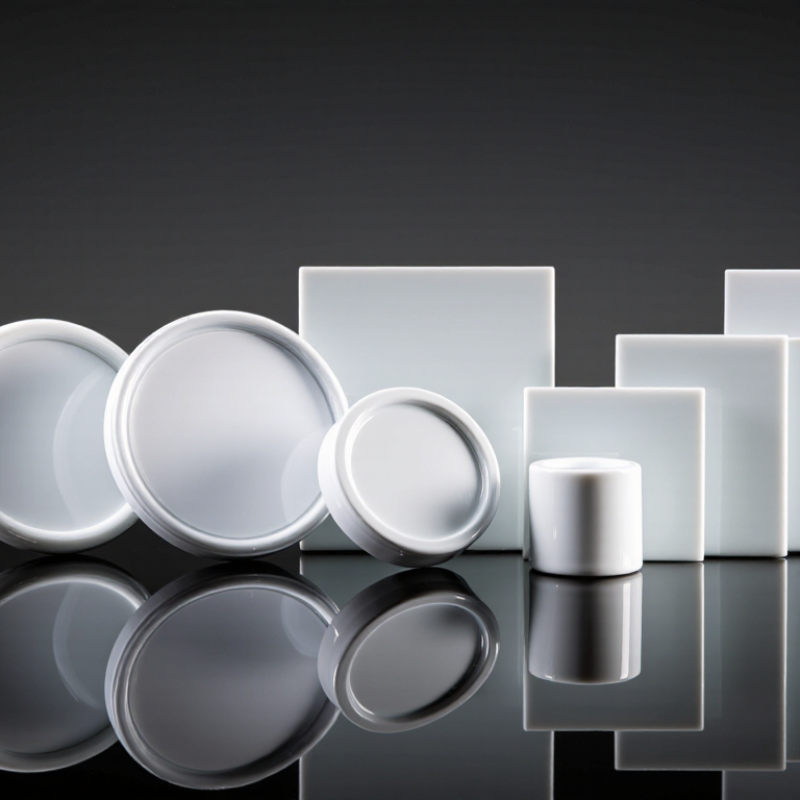
Ceramic laser reflectors combine a heat-resistant substrate with a carefully engineered reflective coating. Alumina offers good electrical insulation and stable performance at moderate power. Silicon carbide handles heat more efficiently and suits demanding optical assemblies. The choice depends on wavelength, beam size, pulse duration, and cooling conditions. Porosity matters too. A dense surface reduces scattering and limits contamination inside microscopic pores.
Reflective performance usually comes from dielectric multilayer coatings. Each thin layer changes the phase of reflected light, strengthening the target wavelength. Metallic coatings can provide broad reflection, but they may absorb more energy.
At high power, even small absorption creates thermal gradients and coating stress. The coating must match the ceramic’s expansion behavior. Otherwise, repeated heating can cause cracking or edge failure.
A credible 10 best comparison should examine measured reflectance, damage threshold, flatness, and thermal cycling results. Surface cleanliness also affects real-world performance. A tiny fingerprint can become a damaged spot under a concentrated beam. During alignment, inspect the reflector under suitable lighting and avoid touching the optical face. I have seen apparently minor scratches distort a reflected spot. That detail is easy to underestimate. Some specifications also omit testing conditions, making comparisons less reliable. Request wavelength-specific data, not only general reflectivity claims.
Selecting among the 10 best ceramic laser reflectors requires more than reading a reflectance claim. A ≥99% value is meaningful only at a defined wavelength, incident angle, polarization, and surface temperature. Technical guidance from ISO 21254 stresses controlled laser-induced damage testing, because coating defects and measurement geometry can change results. At 1064 nm, for example, a reflector rated above 99% may perform differently at 1030 nm or across a broadband source. Narrow-band performance is common.
Professional optics reports and SPIE conference data frequently show that ceramic reflectors achieve their highest efficiency inside a designed spectral band. Buyers should request the actual reflectance curve, not a single percentage. A 2024 industrial laser market analysis also identifies higher-power fiber systems as a major growth area, increasing demand for stable thermal performance. That trend makes absorption important. Even 1% absorption can create noticeable heating at kilowatt-level power.
Damage threshold should include pulse width, repetition rate, spot size, and test method. ISO 21254 results are not automatically interchangeable between suppliers. Nanosecond, picosecond, and continuous-wave systems stress ceramics differently. Ask for measured values in J/cm² or MW/cm². Then compare them with a safety margin. This is where many “best” lists feel incomplete. Reflectance alone cannot predict service life, especially when contamination, vibration, or imperfect alignment enters the system.
Ceramic laser reflectors should be ranked by heat management, not reflectivity alone. ISO 11146 recommends reporting beam diameter through D4σ measurements, because a small hot spot can hide dangerous power density. ASM Handbook Volume 4C lists thermal conductivity near 140–180 W/m·K for aluminum nitride, compared with roughly 20–30 W/m·K for dense alumina. That difference matters during continuous-wave operation.
My practical ranking is: 1) water-cooled aluminum nitride with a polished dielectric surface; 2) silicon carbide for high thermal shock; 3) aluminum nitride with segmented cooling channels; 4) high-purity alumina for moderate beam sizes; 5) zirconia for low-load alignment paths; 6) alumina with a compliant mounting layer; 7) silicon carbide with an oversized aperture; 8) aluminum nitride for pulsed beams; 9) glazed alumina for compact systems; 10) zirconia for low-power reference reflectors. The ranking changes with wavelength, coating absorption, and beam profile.
Power density is only half the test. Thermal load depends on absorbed power, mounting resistance, coolant temperature, and exposure time. IEC 60825-1 safety guidance supports evaluating accessible radiation, but it does not replace thermal qualification. For a 10 mm beam, a 1 kW load averages about 1.27 kW/cm² before absorption losses. That number looks manageable. Edge heating may disagree. In real assemblies, imperfect flatness and contamination often reduce performance earlier than the ceramic itself.
10 Best Ceramic Laser Reflectors for Laser Systems
Top Ceramic Reflectors for CO₂, Nd:YAG, and Fiber Laser Systems
Ceramic laser reflectors support demanding systems where heat, alignment, and wavelength control matter. CO₂ lasers require surfaces designed for 10.6-micron infrared radiation. Nd:YAG systems commonly operate near 1.064 microns. Fiber lasers may use ceramic reflectors around pump modules, beam enclosures, or specialized optical assemblies. They are not interchangeable. That matters.
For Nd:YAG systems, inspect reflectivity, coating adhesion, and thermal expansion before installation. A reflector with a smooth finish can reduce scattering inside a resonator. CO₂ applications need compatible infrared coatings and stable mounting hardware. Fiber systems often place tighter demands on compact geometry and heat removal. In testing, even a small alignment error can create uneven heating across the reflector. Check the edges. They are easy to overlook.
Material purity also affects durability under repeated laser exposure. Look for low porosity, consistent density, and documented wavelength performance. Ceramic bodies can survive temperature changes well, but coatings may age sooner than expected. Cleaning is another weak point. A tiny dust mark can become a hot spot at high power. I would not select a reflector from reflectivity data alone. The published figures may use ideal laboratory conditions. Real systems include vibration, contamination, and imperfect alignment. A careful design review should compare wavelength, power density, cooling, mounting stress, and inspection access before choosing among the ten leading reflector types.
| No. | Reflector Configuration | Typical Laser System | Common Ceramic Material | Typical Wavelength Range | Reflector Geometry | Typical Dimensions | Thermal Characteristics | Surface and Reflectance Guidance | Best-Suited Application |
|---|---|---|---|---|---|---|---|---|---|
| 1 | Elliptical Pump-Chamber Reflector | Nd:YAG flashlamp-pumped laser | High-purity alumina ceramic | Approximately 0.4–1.1 µm | Two-focus elliptical cavity | Typical length: 80–180 mm Internal minor axis: 20–45 mm | High-temperature operation with good thermal-shock resistance; suitable for pulsed lamp pumping | Diffuse white ceramic surface; reflectance depends strongly on porosity, finish, and wavelength | Concentrating flashlamp radiation around a Nd:YAG rod |
| 2 | Cylindrical Side-Pump Reflector | Nd:YAG rod laser | Dense alumina or alumina-based ceramic | Approximately 0.5–1.1 µm | Partial cylindrical or semicylindrical channel | Typical length: 60–150 mm Channel diameter: 8–25 mm | Stable under repetitive pulsed pumping and forced-air or liquid-cooled assemblies | Uniform internal finish helps distribute pump light around the gain rod | Compact side-pumped solid-state laser heads |
| 3 | Arc-Lamp Pump Cavity Insert | Continuous-wave or quasi-CW Nd:YAG laser | High-density alumina ceramic | Approximately 0.4–1.0 µm | Long elliptical or compound curved cavity | Typical length: 100–250 mm Wall thickness: 3–8 mm | Designed for prolonged exposure to intense visible and near-infrared pump radiation | Low-contamination ceramic is preferred for stable optical performance and service life | High-duty-cycle lamp-pumped industrial laser systems |
| 4 | CO₂ Laser Beam-Path Reflector | CO₂ laser at 10.6 µm | Alumina ceramic or silicon-carbide-based ceramic | Approximately 9.3–10.6 µm | Flat, curved, or channel-shaped reflector support | Typical length: 50–200 mm Width: 20–80 mm | Good resistance to thermal loading; requires material qualification at the operating infrared wavelength | Not equivalent to a polished metal mirror; diffuse reflectance and absorption must be measured at 10.6 µm | Thermal shielding, cavity lining, and pump or radiation management around CO₂ laser assemblies |
| 5 | Fiber-Laser Pump-Light Reflector | Ytterbium-doped fiber laser pump module | High-purity alumina ceramic | Typically 0.8–1.0 µm | Small curved cavity or segmented reflector | Typical length: 20–80 mm Channel diameter: 4–15 mm | Electrically insulating and compatible with compact thermally managed pump modules | Used for diffuse redistribution of diode pump light rather than precision beam steering | Improving pump-light utilization around fiber-coupled gain modules |
| 6 | Diode-Pumped Rod Cavity Reflector | Diode-pumped Nd:YAG or Nd:YVO₄ laser | Fine-grain alumina ceramic | Approximately 0.8–0.95 µm | Compact cylindrical or faceted cavity | Typical length: 25–100 mm Internal diameter: 3–12 mm | Suitable for moderate continuous or pulsed thermal loads in compact laser packages | Fine, clean surfaces help reduce particle contamination near diode emitters and gain media | Compact diode-pumped solid-state laser modules |
| 7 | High-Temperature Ceramic End Reflector | Nd:YAG, Nd:YLF, or other solid-state laser cavities | Alumina ceramic with high-temperature glaze or coating | Application-dependent; commonly 0.7–1.1 µm | Flat end plate or shallow concave profile | Typical diameter: 15–60 mm Thickness: 3–10 mm | Handles elevated cavity temperatures and provides electrical insulation | Surface treatment must be selected for the required wavelength and allowed absorption level | End-of-cavity radiation management and thermal protection |
| 8 | Segmented Multi-Arc Reflector | High-power lamp-pumped Nd:YAG system | High-density alumina ceramic segments | Approximately 0.4–1.1 µm | Multiple interlocking curved sections | Segment length: 30–120 mm Segment width: 10–40 mm | Individual segments can accommodate thermal expansion and simplify replacement | Segment alignment and uniformity are important for balanced pump distribution | Large-aperture, serviceable pump chambers |
| 9 | Water-Cooled Pump-Cavity Reflector | High-repetition-rate Nd:YAG laser | Dense alumina or alumina-based refractory ceramic | Approximately 0.5–1.1 µm | Curved cavity with coolant-compatible mounting interface | Typical length: 70–200 mm Wall thickness: 4–10 mm | Designed for use near actively cooled lamp, rod, or cavity components | Low open porosity and chemically stable surfaces are preferred where coolant exposure is possible | High-repetition-rate industrial and laboratory laser resonators |
| 10 | Custom Polygonal Ceramic Reflector | CO₂, Nd:YAG, fiber, or application-specific laser system | Alumina, zirconia-toughened alumina, or silicon-carbide-based ceramic | Specified according to the operating wavelength | Polygonal, faceted, or hybrid curved geometry | Typical envelope: 20–300 mm Thickness: 2–12 mm | Selected for dimensional stability, electrical insulation, and resistance to thermal cycling | Optical performance must be verified at the exact wavelength; geometry is normally application-specific | Specialized pump cavities, thermal shields, and compact custom laser assemblies |
Technical values are representative engineering ranges for ceramic reflector designs. Actual performance depends on ceramic grade, porosity, surface finish, geometry, coating, wavelength, cooling method, and incident laser power; final dimensions and reflectance should be validated for the specific laser system.
For laser systems above 1 kW, ceramic reflectors require more than a high-reflectance rating. IEC 60825-1:2014 treats accessible laser radiation as a major safety concern, while ISO 11553-1:2020 requires risk controls for laser-processing equipment. These standards do not approve a reflector by material name. They demand evidence from the complete assembly, wavelength, beam profile, and operating conditions.
Service-life testing should record reflectance before and after repeated thermal exposure. A practical test can use continuous power above the intended rating, controlled duty cycles, and infrared temperature mapping. Inspectors should check microcracks, coating loss, edge chipping, and changes in beam direction. ASTM C1161 provides a recognized method for measuring ceramic flexural strength, but strength alone does not predict optical durability. That distinction is often missed.
A 1 kW beam can create severe localized heating, especially when contamination reduces reflectance. Cleanliness matters. Test reports should include wavelength, incident angle, spot size, power density, cooling method, and exposure duration. Independent laboratories can improve credibility through calibrated power meters and traceable temperature sensors. Still, no test fully represents every workshop. Real alignment errors, dust, vibration, and thermal cycling may shorten service life. Engineers should treat published lifetime claims as conditional, not permanent.
© Copyright 2025 | LittleFirefighter.com | All Rights Reserved | 1EZ Creative: Orange County Web Design

Fusce ut ipsum tincidunt, porta nisl sollicitudin, vulputate nunc. Cras commodo leo ac nunc convallis ets efficitur.

12345 North Main Street,
New York, NY 555555
1.800.555.6789
sale@vibrotools.com
