What Is the Best New Energy Car Production Line in 2026?
The best New Energy Car Production Line in 2026 will depend on what a manufacturer needs to build, and at what scale. A line designed for high-volume electric sedans may not suit a flexible plant assembling several vehicle types. Battery chemistry, production targets, available floor space, and local service support all affect the choice. There is no single winner for every factory.
A useful evaluation starts with the actual workflow: battery-pack assembly, body welding, painting, final assembly, and end-of-line testing. Can the equipment maintain consistent quality without slowing production when models change? Ask suppliers for verified cycle-time data, uptime records, safety documentation, and references from comparable installations. Inspect details on site, such as how technicians access a robot cell or how quickly a faulty conveyor can be isolated. Small details matter.
Automation deserves careful scrutiny. More robots can improve repeatability, but they may add maintenance costs and make production less adaptable. Software integration matters too; production systems should provide traceable quality data and connect reliably with existing equipment. Request a clear plan for commissioning, staff training, spare parts, and future upgrades. Independent testing and transparent performance terms can help separate demonstrated capability from sales claims. Even then, projections are not guarantees. A well-chosen line balances output, quality, flexibility, worker safety, and total ownership cost. The right answer is the system that performs reliably under the factory’s real operating conditions—not simply the one with the most impressive specifications.
What Defines a New Energy Vehicle Production Line in 2026?
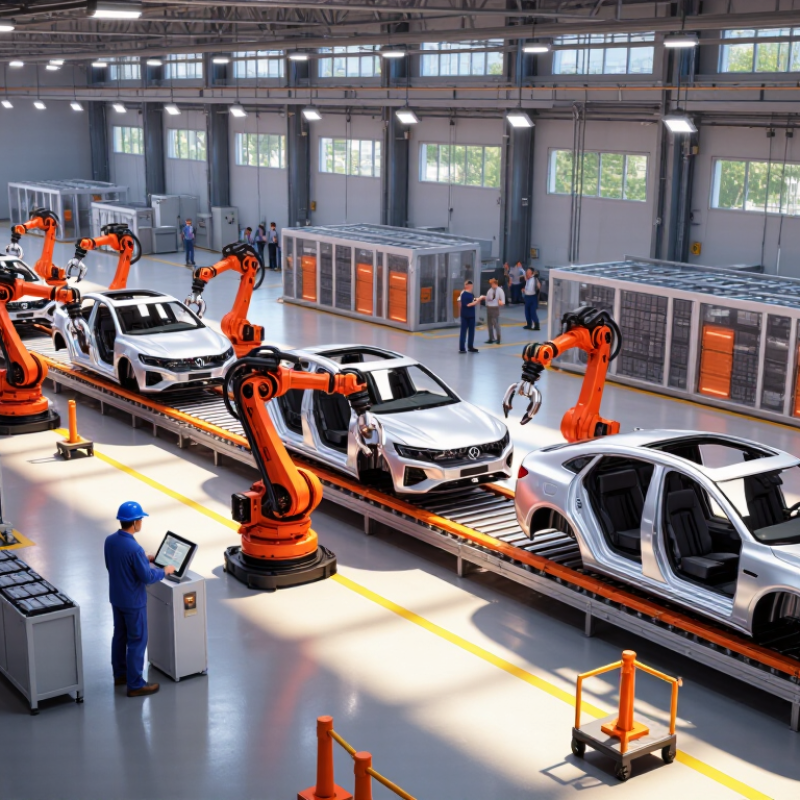
In 2026, a new energy vehicle production line is more than a conventional factory with battery installation added. It coordinates battery-pack handling, body assembly, power electronics, software loading, and final vehicle testing. The IEA’s Global EV Outlook 2025 reports that electric-car sales exceeded 17 million in 2024, roughly one-fifth of global car sales. That scale changes the question: can each station maintain safety and traceability at volume?
A defining feature is a connected production record. A pack station can log cell identifiers, weld settings, and torque curves, then link them to insulation and leak-test results. Software versions and end-of-line test data should follow the same vehicle record. Not just speed. In practice, a small error in a connector or seal can trigger expensive rework later.
Resilience matters, too. The IEA’s Global Critical Minerals Outlook 2024 reports that the three largest refining countries held an average 86% share across key energy minerals in 2023. A production line cannot solve that concentration, but qualified material options and flexible stations can help manage disruption. A perfect digital twin is not the definition. Real lines still face downtime, messy changeovers, and data gaps; a polished dashboard may not show all three.
Core Technologies Used in Modern Vehicle Manufacturing
In 2026, the best new-energy vehicle production line is not simply the fastest one. It connects battery assembly, body construction, software calibration, and final inspection in a controlled, traceable process. During a shift, laser sensors can measure panel gaps while robotic systems apply consistent welds. But accuracy depends on clean fixtures and calibrated tools, not automation alone.
Battery production requires close process control. Automated dispensers place measured adhesive beads, and machine vision checks cell orientation before modules move onward. Torque tools record fastening values, while thermal cameras can flag unusual heat during selected tests.
These records help engineers trace a defect to a station instead of guessing. Small errors matter. A misplaced seal or loose connection may seem minor, yet affect durability and safety.
Digital twins can help reveal bottlenecks, though their predictions are only as reliable as their data.
A capable line also tests finished vehicles under repeatable conditions. End-of-line stations verify charging, braking, sensors, and communication between control units. Human technicians still review exceptions and investigate patterns that software may miss. One weak point remains: data can look complete while a real-world fault slips through. The most useful technology is the kind that helps teams catch that gap and correct it.
Key Criteria for Comparing Production Lines
Comparing a new energy car production line in 2026 starts with its intended output, not its advertised automation level. A line designed for 120,000 vehicles annually may struggle when frequent model changes disrupt takt time. Ask for cycle-time data across regular shifts, changeovers, and planned maintenance. A polished demonstration is not enough.
Measure flexibility in minutes and tooling requirements, not slogans. Check whether body-shop fixtures, software, and material flow can support different vehicle configurations without lengthy stoppages. Battery-pack handling deserves close attention. Review lifting accuracy, fastening traceability, leak-test coverage, and procedures for isolating rejected packs. Small variations matter. Compare energy use per vehicle, compressed-air demand, scrap rates, and rework hours using data from a representative operating period.
Uptime figures need clear definitions. Ask whether they include minor stops, and verify maintenance records against production logs. Examine spare-parts availability, technician training, and how quickly a fault can be diagnosed. These details affect real output. A spreadsheet can still flatter a line if it excludes difficult shifts or early ramp-up losses. I would treat supplier projections as estimates, then check them against comparable operating evidence. Perfect data is rare, and that should be acknowledged.
Leading Production Line Configurations and Their Strengths
What Is the Best New Energy Car Production Line in 2026?
Leading Production Line Configurations and Their Strengths
There is no single production line that suits every new energy vehicle plant. The right setup depends on output targets, vehicle variety, and how often designs may change. A modular line uses adaptable stations and reconfigurable fixtures. It can support multiple vehicle versions without rebuilding the entire floor. That matters. However, frequent changeovers can still interrupt production, especially when parts arrive late or operators need retraining.
A high-volume dedicated line is built around repeatable tasks, fixed stations, and tightly balanced cycle times. It can produce large numbers of similar vehicles with steady process control. Automated fastening tools can record torque, while cameras check component placement. These details help catch problems early. The trade-off is limited flexibility: a major model change may require costly equipment adjustments and fresh validation.
A hybrid configuration combines dedicated equipment for predictable, high-volume tasks with flexible cells for variable work. For example, a plant might automate battery-pack handling while keeping selected trim or inspection stations adaptable. Traceability systems can link assembly records to each vehicle, but dashboards alone do not guarantee quality. Teams still need to investigate recurring defects and verify measurements on the line. Sometimes the simplest station is the bottleneck. Planning should include maintenance access, worker feedback, and realistic ramp-up time—not just the target production rate.
How to Choose the Best Line for a Manufacturer’s Needs
Choosing the best new energy car production line in 2026 starts with the vehicles a manufacturer plans to build. A line designed for one battery pack size may struggle when models change. Compare expected daily output with realistic shift hours, planned maintenance, and changeover time. Rated speed alone can mislead. Check the slowest process, such as battery installation or end-of-line testing, because it may limit the whole line.
Battery handling deserves close attention. Ask how the line controls lifting, fastening, and connection checks, and how each result is recorded. Traceable records help teams investigate defects without relying on memory. The layout should also leave clear access for technicians and emergency response equipment. Small details matter. Measure actual floor space, column locations, and material routes before approving a design. A paper layout can look efficient and still create crowded work areas.
Flexibility should be practical, not just promised. Review the time and tooling needed to switch models, and confirm that operators can perform the change safely. Ask for trial-run data using parts similar to the manufacturer’s own components. Verify how production equipment connects with existing quality and planning systems. Maintenance access, spare-part availability, training, and supplier support affect uptime after launch. One assumption often gets missed: forecasts change. Leave room for product updates, but avoid paying for capacity the plant cannot use. A pilot phase can expose issues; it may also reveal that the original target was too optimistic.