
China’s cross-border trucking market connects factories, distribution hubs, and overseas customers through busy roads and carefully timed handoffs. Choosing a carrier involves more than comparing fleet size or quoted rates. A delayed border crossing, an unclear shipment update, or a missed delivery window can disrupt an entire supply chain.
As American Trucking Associations president Chris Spear has described trucking, “the backbone of the U.S. economy.” Cross Border Trucking depends on that practical foundation: reliable vehicles, experienced dispatchers, clear shipment tracking, and teams that understand route requirements. For China-related freight, businesses should also check each provider’s service coverage, cargo handling, insurance terms, and ability to coordinate with qualified customs professionals.
A ranked list is a starting point, not a guarantee. Public company information can be uneven, and service quality may vary by route, season, and shipment type. Details matter. Think of a sealed trailer waiting at a border facility, a driver checking updated instructions, and a logistics team coordinating the next handoff. Those moments reveal more than a promotional slogan.
This guide introduces ten companies associated with China cross-border trucking and explains what to examine before requesting a quote. Compare documented capabilities, communication practices, transit estimates, and experience on your specific corridor. There is no perfect ranking. The right partner is the one that can clearly explain its process, meet your shipment needs, and operate in accordance with applicable requirements.
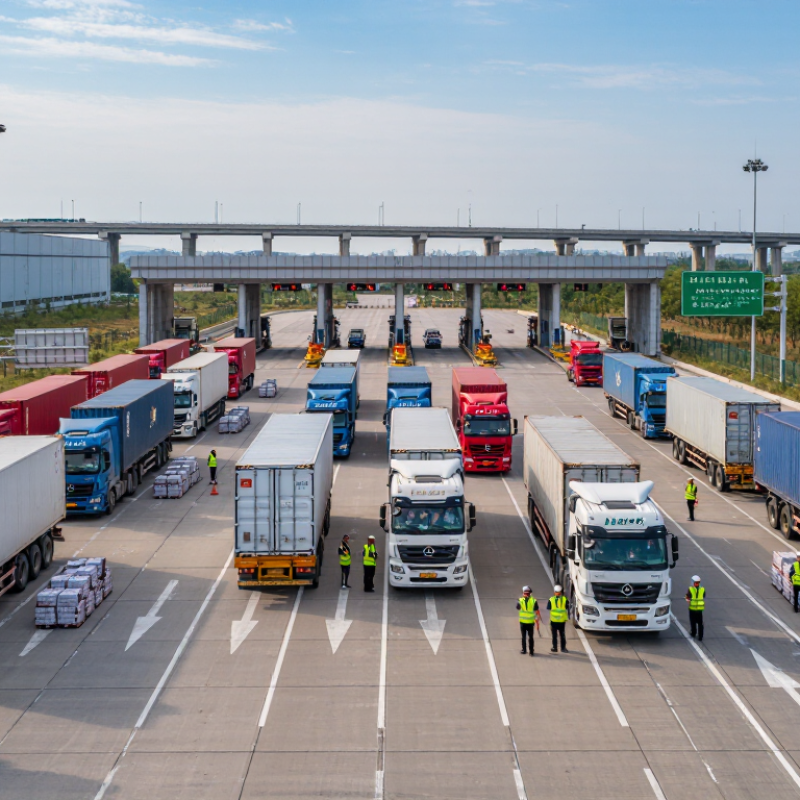
Cross-border trucking in China is the road movement of goods between China and another country, with a truck crossing an international land border. It may cover the full journey or only one leg. For example, a load can leave a factory inland, travel by road to a border checkpoint, and continue toward a neighboring market. If the cargo moves only to a seaport or rail terminal, that is not necessarily cross-border trucking. That distinction matters.
The work involves more than driving. Teams must coordinate routes, customs documents, vehicle and driver requirements, inspections, and delivery times. At a border, a truck may wait while documents and cargo details are checked; in some routes, goods are transferred to another vehicle. A pallet count or description that differs across records can slow the handoff. Details vary. In practice, the term is not always used consistently: some people describe the entire door-to-door journey, while others mean only the international road segment. Clear definitions help customers compare service scope, transit estimates, and handling responsibilities without assuming every shipment follows the same process.
Cross-border trucking moves goods by road across an international border, involving customs clearance and compliance with the rules of each country. These approximate border lengths show geographic context, not trucking volumes, route availability, or company performance; actual access depends on border facilities, regulations, and permits.
Ranking China’s cross-border trucking companies requires more than comparing quoted rates. Start with route-level capability: ask which border crossings, inland hubs, and delivery regions the operator serves regularly. Request recent examples for similar cargo, lanes, and shipment sizes, with customer details appropriately protected. Experience should show in practical answers, not broad claims. Can the team explain handoffs, expected transit ranges, and what happens when a truck misses a planned connection? Small details matter. A clear escalation contact can save hours when a delivery slot changes.
Check operational controls before comparing the shortlist. Review vehicle condition records, driver training, cargo security procedures, insurance scope, and tracking updates at each handoff. Ask for written service measures, including pickup punctuality, proof-of-delivery timing, and delay reporting. Compare quotations line by line; clarify charges for waiting time, storage, or route changes. Do not treat the lowest price as the best value. A polished website is not proof of dependable execution. No scorecard removes uncertainty, and a neat spreadsheet can hide weak assumptions. Speak with the dispatch team, test response times, and verify references where possible. Weigh reliability, communication, and realistic capacity against cost.
This is a company-selection framework, not a ranking of named providers. The weights are suggested evaluation weights; assess each candidate using comparable shipment records, documents, and service quotations.
| Rank | Evaluation Criterion | Suggested Weight | Evidence to Review | Suggested Measurement |
|---|---|---|---|---|
| 1 | Customs and trade compliance | 15% | Customs-clearance procedures, document checks, brokerage arrangements, and records of holds or corrections. | Score against documented compliance processes and the rate of shipment files requiring correction. |
| 2 | On-time delivery performance | 15% | Recent delivery records for comparable routes, service levels, cargo types, and border crossings. | Compare the percentage of shipments delivered within the agreed delivery window. |
| 3 | Route and service coverage | 12% | Operating lanes, border-crossing options, service frequency, and arrangements for first- and last-mile transport. | Confirm that the provider can serve each required origin, destination, and border point. |
| 4 | Shipment visibility and communication | 10% | Tracking milestones, status-update frequency, proof-of-delivery access, and escalation contacts. | Check milestone coverage and response times during a trial shipment or reference check. |
| 5 | Fleet and capacity suitability | 10% | Vehicle types, load limits, equipment availability, subcontracting practices, and peak-season capacity plans. | Match available equipment and capacity to shipment volume, dimensions, and handling requirements. |
| 6 | Safety and cargo security | 10% | Driver and vehicle safety procedures, cargo-security controls, incident reporting, and insurance documentation. | Review written procedures and comparable records of damage, loss, and safety incidents. |
| 7 | Rate transparency and total cost | 10% | Itemized quotations covering transport, border-related charges, handling, waiting time, and potential surcharges. | Compare like-for-like total landed transport costs and the clarity of charge conditions. |
| 8 | Claims handling and service recovery | 8% | Claims submission requirements, investigation steps, escalation process, and published service commitments. | Assess process clarity and review documented resolution times for comparable claims. |
| 9 | Customer support and operational expertise | 5% | Availability of operational contacts, language support, route knowledge, and issue-escalation arrangements. | Evaluate response quality and continuity of support during a route-specific consultation. |
| 10 | Environmental reporting and efficiency | 5% | Fuel-efficiency initiatives, vehicle information, emissions-reporting methods, and shipment-consolidation options. | Compare the availability and consistency of relevant environmental data for the proposed service. |
| Total Suggested Weight | 100% | Apply the same evidence standards and scoring method to every candidate. | ||
Public data rarely supports a precise ranking of China’s cross-border trucking companies. The World Bank’s 2023 Logistics Performance Index ranked China 19th, with a score of 3.7. This measures national logistics performance, not individual carriers. That distinction matters.
A useful profile set starts with a northern-border fleet serving scheduled regional routes, and a western-corridor operator coordinating long-haul truck movements. A mountain-route specialist plans around weather and changing travel times. A temperature-controlled carrier monitors cargo conditions during transit. An urgent-freight operator focuses on dependable departure windows. Details matter. A customs-integrated provider coordinates documents and handoffs. A multimodal operator combines road legs with rail connections. A consolidation service groups smaller shipments for fuller loads. A digital-first carrier offers shipment tracking and estimated arrival updates. A heavy-cargo specialist plans vehicle capacity and route access in advance. These are operating profiles, not verified company rankings; service coverage can change by season and route. Buyers should check current lane schedules, insurance terms, tracking detail, and delivery records before selecting a provider. Some published claims remain hard to compare. Independent, route-level performance data is still limited.
China’s cross-border trucking network is best judged by route fit, border handling, and regional reach. Southbound services commonly connect Guangxi with Vietnam through Pingxiang, and Yunnan with Laos through Mohan. These corridors suit scheduled groupage, full-truck loads, and temperature-controlled cargo. Westbound freight moves through Xinjiang gateways such as Horgos and Alashankou toward Central Asia. Northern routes link border hubs with Russia and Mongolia, where winter conditions can disrupt transit plans.
A useful carrier comparison checks door-to-door coverage, customs-document support, shipment tracking, and backup capacity at border depots. Ask whether quoted transit times include inspections and cargo transfer; a truck may not continue across the border under the same operating arrangement. Queues still matter. The World Bank’s 2023 Logistics Performance Index scored China 3.7 out of 5 and ranked it 19th among 139 economies. That national score provides context, not a rating of individual trucking companies. For buyers assessing the top ten providers, compare route-specific delivery records and claims handling, not just fleet size. Regional coverage can look broad on a map, yet service beyond major gateways may rely on local partners. Planning is never perfect; weather, congestion, and mismatched operating hours still create delays.
Choosing among China’s leading cross-border trucking providers depends more on the shipment than on a universal top-ten ranking. A factory sending palletized goods to a nearby border may value frequent departures and predictable handoffs. A seller moving urgent cartons may prioritize booking flexibility and real-time tracking. Different needs, different strengths.
Compare providers on route coverage, customs-document support, transit estimates, and how clearly they explain extra charges. Ask what happens when a truck misses a scheduled crossing. A useful answer names the next step, not just “we will update you.” For temperature-sensitive cargo, check equipment records and monitoring procedures. For bulky freight, confirm loading limits and whether the quoted price includes border transfers. Small details matter.
Reliability shows up in ordinary moments: a status update before a delay becomes a surprise, or a revised delivery window that matches the route. Request sample tracking updates and a written breakdown of accessorial fees. Then compare quotes for the same cargo, service level, and delivery point. The cheapest figure can hide a transfer fee. I would not treat a polished dashboard as proof of strong operations; it helps, but it is not the whole picture. Some lanes also change with seasonal congestion, so confirm current schedules before committing.
© Copyright 2025 | LittleFirefighter.com | All Rights Reserved | 1EZ Creative: Orange County Web Design

Fusce ut ipsum tincidunt, porta nisl sollicitudin, vulputate nunc. Cras commodo leo ac nunc convallis ets efficitur.

12345 North Main Street,
New York, NY 555555
1.800.555.6789
sale@vibrotools.com
