
Choosing a top Shipping Tarp supplier in China takes more than comparing prices. A tarp may look sturdy in a product photo, yet fail after weeks of wind, rain, and repeated handling. The difference often lies in fabric weight, coating consistency, seam construction, and quality checks before shipment. Small details matter.
Shipping-tarp sourcing consultant Lin Wei offers this practical reminder: “A reliable tarp is proven by its seams, specifications, and performance—not by a low quote alone.” Use that idea to guide your supplier review. Ask for clear material specifications, production photographs, sample options, and written inspection criteria. Check whether the supplier explains how it controls UV resistance, waterproofing, edge reinforcement, and grommet spacing. Specific answers are more useful than broad promises.
This guide outlines how to assess manufacturing capability, verify product quality, compare communication and lead times, and request samples effectively. It also considers export experience and after-sales support, since a smooth first conversation does not guarantee a dependable production run. Be cautious with claims that sound perfect. A sample can perform well while a bulk order varies; that possibility deserves a direct question. No checklist removes every risk, but careful checks can make supplier selection more informed, practical, and less dependent on guesswork.
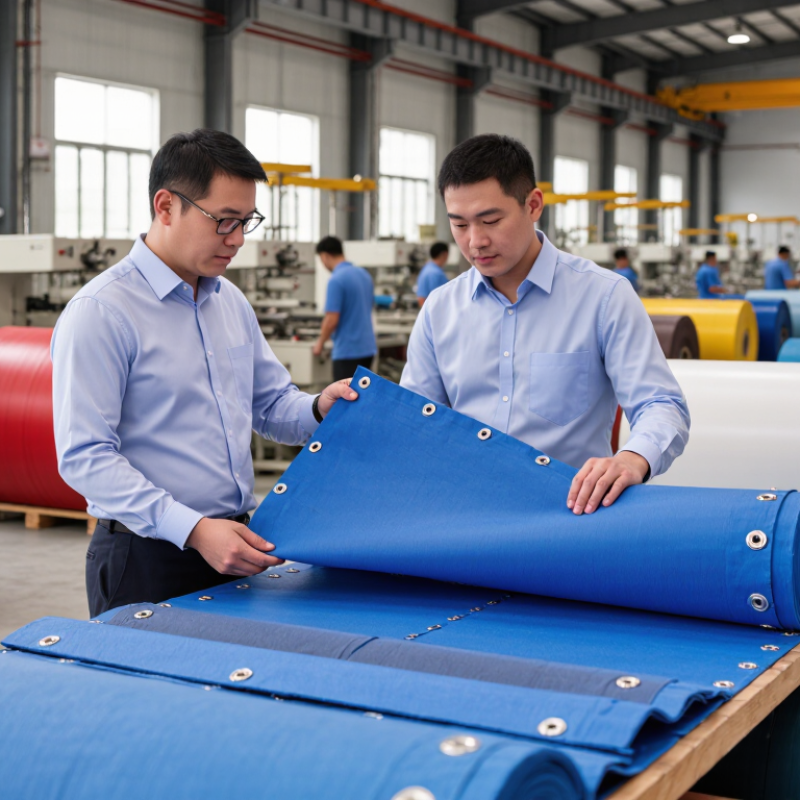
Define the job before requesting a quote. Record the covered load’s length, width, height, sharp edges, and tie-down points. Specify whether the tarp will face road spray, standing water, strong sun, or repeated folding. A warehouse cover and an exposed truck cover need different construction. Small details matter.
UNCTAD’s Review of Maritime Transport 2024 reports that maritime trade grew 2.4% in 2023, with further growth forecast. That scale makes varied routes and handling conditions worth considering, but it does not set your tarp specification. Ask suppliers for fabric weight, coating type, seam construction, grommet spacing, and tested tensile and tear strength. ASTM D751 provides test methods for coated fabrics; request results tied to the exact material offered, not a generic product sheet. A high GSM number alone proves little. Check UV and temperature performance against your actual route, too. Some buyers overlook abrasion from cargo corners. That can be costly.
Write measurable acceptance criteria into the inquiry: dimensions and tolerance, water resistance, color, repairability, and expected reuse. Include photos of the load and loading method. If requirements are still uncertain, say so and ask for a sample for fit and handling checks. Better to test one awkward corner now. A neat specification can still miss real handling conditions.
Estimate the tarp area needed to cover different cargo sizes before comparing suppliers.
How to read this chart: The estimates assume the tarp covers the top and sides, with 0.5 m of extra material on each edge. Estimated tarp dimensions are calculated as (cargo length + 2 × height + 1 m) by (cargo width + 2 × height + 1 m). These are planning examples, not market statistics; allow for roof pitch, securing points, and any additional overhang required for your shipment.
A supplier’s years in business can offer useful context, but experience should be visible in its work. Ask how long the team has produced shipping tarps and which constructions it handles regularly. Look for practical details: fabric weights, seam methods, reinforcement layouts, and how staff manage custom sizes. A capable supplier should explain these choices clearly, not rely on broad claims. Ask to see recent production records or sample inspection notes. Numbers matter.
Production capacity is more than the number of machines on a factory floor. Check how many cutting, welding, or sewing stations are active, and ask about typical monthly output. Then compare that figure with your order size and requested delivery schedule. A factory may handle a normal month well but struggle during seasonal peaks. Ask how it plans labor, material supply, and quality checks when orders rise. If possible, review a sample tarp and inspect its hems, grommet spacing, and corner reinforcement.
A factory visit or live video walkthrough can help confirm that equipment and work areas match the supplier’s description. Ask to see one order move from material inspection to packing. Notice whether staff record defects and separate questionable pieces. This check is imperfect; a polished tour cannot prove every shipment will be consistent. I would also ask for a recent example of a delayed order and how the team responded. Honest, specific answers are often more useful than impressive capacity figures alone.
| Assessment Dimension | Suggested Weight | What to Check | Evidence of a Strong Supplier |
|---|---|---|---|
| Relevant manufacturing experience | 15% | Years producing coated or laminated tarpaulins, shipping covers, or comparable technical fabrics; experience with products similar to your required construction. | Consistent production records, product specifications, and references for comparable orders. Confirm that the experience relates to manufacturing rather than trading alone. |
| Production capacity | 15% | Monthly output for the relevant product, current production load, number of shifts, and capacity available during your required production window. | A capacity statement supported by production schedules and a realistic lead-time plan. Check whether quoted output is for the same material, size, and finishing process. |
| Equipment and process control | 12% | Availability of coating or lamination, cutting, welding or sewing, eyelet installation, and packing equipment appropriate to the order. | Process flow and equipment records that match the product specification. Ask how machine settings and in-process checks are documented. |
| Material and product knowledge | 12% | Understanding of fabric construction, coating, dimensions, UV exposure, water resistance, tear strength, and intended transport conditions. | Clear technical answers and a written specification identifying material, thickness or weight, dimensions, reinforcement, and applicable test methods. |
| Quality management | 14% | Incoming-material inspection, in-process checks, final inspection, defect handling, and traceability of production batches. | Documented inspection procedures, inspection records, and corrective-action examples. Verify any claimed management-system certification with the issuing body. |
| Testing and sample approval | 10% | Ability to provide pre-production samples and test results relevant to the agreed requirements, such as dimensions, coating weight, or seam strength. | Samples made using the proposed materials and processes, with results tied to identifiable samples or batches. Agree on acceptance criteria before mass production. |
| Order and delivery planning | 8% | Lead time for sampling and production, raw-material availability, order milestones, packing method, and export-document coordination. | A dated production schedule with clear responsibilities and contingency steps. Confirm the delivery estimate against order size and current production commitments. |
| Export and communication capability | 7% | Experience preparing export documents, communicating technical changes, and coordinating shipment requirements for the destination market. | Prompt, consistent written responses and accurate order documentation. Confirm who handles export coordination and how changes are approved. |
| Capacity verification | 7% | Whether the stated factory location, production resources, and subcontracting arrangements can be independently checked. | A factory visit or third-party audit, where practical, confirms the relevant production processes. Any subcontracted steps are disclosed and included in quality controls. |
The weights are a suggested buyer evaluation framework, not a universal industry standard. Adjust them to the product specification, order volume, and delivery requirements; verify claims with samples, records, and independent checks where appropriate.
When comparing a shipping tarp supplier in China, start with the fabric, not the catalog photo. PVC-coated polyester often suits repeated outdoor use; woven polyethylene can be lighter and more economical. Ask for fabric weight, yarn specification, coating thickness, UV-resistance results, and operating-temperature range. Textile Exchange’s Materials Market Report 2024 estimates global fiber production reached 124 million tonnes in 2023, with polyester accounting for 57%. That scale signals broad availability, not consistent tarp performance. Numbers can mislead.
Check how the supplier controls each production batch. Request recent test reports for tensile strength, tear resistance, coating adhesion, and water penetration. ASTM D751 provides test methods for coated fabrics; confirm the report identifies the tested material and method. Inspect a physical sample, especially its hems, eyelets, and seams. Pull the reinforcement near an eyelet. It should not split or expose loose threads. Ask how defects are recorded and whether batch numbers link finished tarps to inspection records. A glossy certificate alone proves little.
Review certifications carefully. ISO 9001 indicates a quality-management system, not that every tarp meets your performance needs. For independent test results, check whether the laboratory is accredited to ISO/IEC 17025 for the relevant tests. Compare certificates, reports, and product specifications by name and date. Ask for one production sample and one retained sample from the same batch. I still find this step easy to skip when deadlines press. It can reveal coating variation before a full order ships.
A low unit price can hide costly differences. When comparing Chinese shipping tarp suppliers, request itemized quotes for fabric weight, coating, finished dimensions, edge reinforcement, grommet spacing, and packaging. A 650 GSM PVC tarp and a lighter polyethylene cover are not equivalent products. Ask whether the quoted price includes sampling, tooling, inspection, and export packaging. Small details matter. I have seen buyers focus on price per square meter, then discover that extra reinforced corners were excluded. That comparison was not fair.
Customization should be confirmed with a signed specification sheet, not just a chat message. Include material tolerance, color reference, seam construction, label placement, and acceptable defect limits. Request a pre-production sample, then compare it with the bulk order. For delivery, separate production time from port-to-door transit and ask what happens if inspection delays dispatch. The World Bank’s Logistics Performance Index 2023 reports an average 44 days for goods to move from an exporter’s warehouse to an importer’s warehouse, with substantial variation. This is not a tarp-specific forecast, but it shows why a promised factory date is not a final arrival date. Get milestone dates in writing. Leave a buffer. And check whether freight terms, customs documents, and damage claims are clearly assigned before paying a deposit.
A reliable supplier should let you assess the product before a large order. Request a sample made to your proposed fabric, coating, and seam specifications. Check its weight, flexibility, edge finishing, grommet placement, and stitching or welds. If the sample differs from the approved specification, pause and ask why. A neat sample is useful, but it cannot prove every production batch will match.
Communication matters after the sample stage. Ask for written tolerances, production updates, and clear answers about packaging and delivery.
McKinsey’s 2021 B2B Pulse found that 70–80% of B2B decision-makers preferred remote human interaction or digital self-service over in-person meetings. This is a broad B2B finding, not a tarp-specific benchmark, but it reinforces the value of responsive, accessible support.
Before ordering, also clarify how defects are documented, who pays for replacements, and how quickly complaints receive a response. Vague warranty wording is a warning sign.
Tips: Send a marked-up sample checklist and request dated photos of the production run. Keep one approved sample for comparison when the shipment arrives. Ask for a named after-sales contact and a written claim process. Details matter. And even careful checks cannot remove every risk.
© Copyright 2025 | LittleFirefighter.com | All Rights Reserved | 1EZ Creative: Orange County Web Design

Fusce ut ipsum tincidunt, porta nisl sollicitudin, vulputate nunc. Cras commodo leo ac nunc convallis ets efficitur.

12345 North Main Street,
New York, NY 555555
1.800.555.6789
sale@vibrotools.com
