
Why Choose Aluminum Contact Wire for Your Project?

Choosing an overhead conductor is not just a materials decision. It affects support loads, installation work, electrical performance, and maintenance planning. Aluminum Contact Wire draws attention because it combines useful conductivity with much lower mass than copper. The Aluminum Association’s Aluminum Electrical Conductor Handbook lists electrical-grade 1350 aluminum at roughly 61% IACS conductivity and a density near 2.70 g/cm³. Copper’s density is about 8.96 g/cm³. That weight difference can matter across long spans, where every kilogram influences the supporting structure. Lighter, though, does not automatically mean better.

The International Energy Agency’s The Future of Rail report discusses rail electrification as part of reducing transport emissions, while the Aluminum Association’s conductor data help explain material trade-offs. Together, they offer useful context, not a final design verdict. In practice, the right contact wire depends on current demand, span length, tension, wear, temperature, and the compatibility of fittings and support equipment. Alloy and conductor construction also matter; conductivity figures for one aluminum grade should not be treated as universal. A project team should check applicable railway specifications and test data before choosing a product. That sounds obvious. It is often missed.

This guide examines where Aluminum Contact Wire can offer practical value, what compromises deserve attention, and which project details should shape the decision. The numbers help. Field conditions still decide.
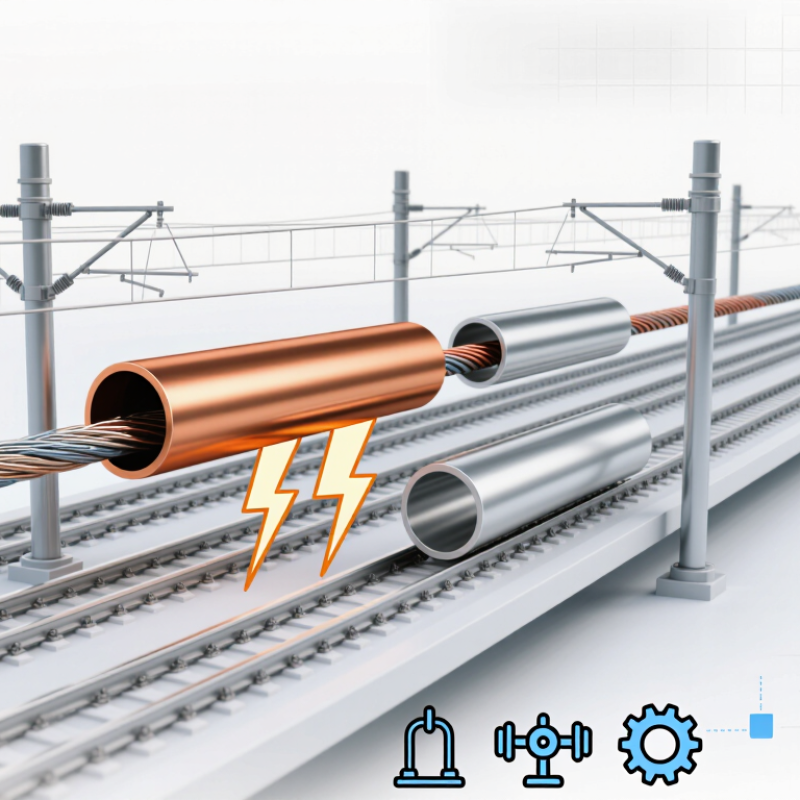
Why Choose Aluminum Contact Wire for Your Project?

What Aluminum Contact Wire Is and How It Works

An aluminum contact wire is the energized conductor in an overhead railway power system. A pantograph’s carbon strip presses against its underside and slides along it, drawing current for the train’s traction equipment. The circuit returns through rails or designated return conductors. You can picture the contact point moving over each support as the train passes.

The Aluminum Association’s Aluminum Electrical Conductor Handbook reports electrical-grade aluminum conductivity at about 61% IACS, where annealed copper is the 100% reference. Aluminum’s density is about 2.70 g/cm³, compared with roughly 8.96 g/cm³ for copper. Lower mass can reduce the load carried by supports, but lower conductivity may require a larger conductor area for the same electrical duty. Actual performance depends on alloy, wire profile, span, tension, current, and operating temperature. It is not a drop-in choice.

Tips: Check the system’s current, temperature, wear, and joint requirements before specifying a wire. A light conductor sounds attractive; its connections can still be the weak point. Verify the design against the railway’s operating conditions and applicable engineering standards.

Key Properties That Shape Its Performance

Aluminum contact wire combines useful electrical conductivity with low weight. That matters. A lighter conductor can reduce the load on supporting structures, especially across long spans. Its conductivity is lower than copper’s by volume, so engineers may select a larger cross-section to meet current and temperature requirements. The exact choice depends on the alloy, wire profile, operating current, and installation conditions.

Strength and durability also shape performance. Aluminum alloys vary in tensile strength, and their behavior under repeated heating should be checked against the project’s design limits. The metal expands with temperature changes, which affects sag and tension. Small details matter. At a work site, even a carefully tensioned wire can behave differently after hot afternoons and cool nights. Aluminum naturally forms an oxide layer that helps resist corrosion, but connectors still need suitable design and preparation for reliable electrical contact. One easy-to-miss point is maintenance access: a lightweight wire does not make inspections unnecessary. Material data and field conditions should guide the final specification.

Where Aluminum Contact Wire Is Commonly Used

Aluminum contact wire is commonly considered for metro, light-rail, and regional railway overhead systems where lower conductor mass can ease loads on poles and support structures. It can also suit new electrification routes with long spans or limited structural capacity. The IEA’s 2019 report, The Future of Rail, estimates that rail carries 8% of global passenger transport and 7% of freight, while using about 2% of transport energy. That scale helps explain why overhead-system choices matter. Still, aluminum is not a direct substitute in every line: conductivity, wear, tension, and connector compatibility need engineering checks.

In practice, project teams assess the full overhead assembly, not just the wire. Aluminum’s lower weight can help in tunnels, on elevated urban tracks, or during route extensions where existing supports have little spare capacity. But contact surfaces face repeated pantograph friction, and material selection must account for that wear. A lighter wire can simplify some installation work; it does not automatically mean lower lifecycle cost. Site conditions and maintenance plans matter.

Tip: Confirm the wire’s alloy, section, joining method, and wear limits against the system design. A small mismatch at a connector can become a recurring maintenance issue. Even experienced teams should review local operating conditions before specifying it.

Benefits Compared with Other Contact Wire Materials

Aluminum contact wire can reduce overhead system weight compared with copper, especially on long spans where dead load affects supporting structures. The Aluminum Association’s material data lists aluminum density at about 2.70 g/cm³; Copper Development Association references place copper near 8.96 g/cm³. Aluminum’s electrical conductivity is lower, however: the International Annealed Copper Standard sets copper at 100% IACS, while common electrical-grade aluminum is about 61% IACS. For similar resistance, aluminum therefore needs roughly 1.6 times the cross-sectional area. Even so, its conductor weight can remain about half that of copper. That matters overhead.

The trade-off is practical, not just numerical. A larger aluminum wire may need more clearance, different fittings, and careful joint design. Contact wires also face friction, vibration, and repeated current collection, so tensile strength and wear performance must be checked against the route’s operating conditions. Copper alloys may offer better wear resistance in some applications, while aluminum can reduce support loads and make handling easier. The right comparison should use complete wire designs, not raw metal properties alone. I would verify the supplier’s resistance, tensile, and wear-test data before specifying a section; weight savings can look persuasive on paper, but installation details still matter.

Factors to Check When Choosing Aluminum Contact Wire

Why Choose Aluminum Contact Wire for Your Project?
Factors to Check When Choosing Aluminum Contact Wire

Choosing aluminum contact wire starts with the electrical and mechanical demands of the route. Check the alloy, cross-sectional area, and specified resistance at operating temperature. Aluminum is lightweight, but it generally needs a larger section than copper to carry comparable current. Confirm that the proposed profile fits the pantograph and support system.

Strength matters too. Review tensile properties, elongation, dimensional tolerances, and surface finish against the project specification. Small profile variations can affect contact behavior and installation tension. Ask for traceable test reports, not just a catalogue sheet. Check how joints, clamps, and dissimilar metals will be handled, since poor interfaces can raise resistance or encourage corrosion. Details matter.

Route conditions deserve equal attention. Wind, vibration, temperature changes, span length, and maintenance access all influence wire selection. A technically suitable wire may still be awkward to install on an existing structure. Consider the complete system, including supports and tensioning equipment. A neat datasheet is not the whole story. It is easy to focus on conductivity and overlook fatigue or field repairs. Verify calculations and acceptance criteria with a qualified electrical or railway engineer before ordering.

Why Choose Aluminum Contact Wire for Your Project? — Factors to Check When Choosing Aluminum Contact Wire

Selection Factor What to Check Useful Reference Why It Matters
Electrical conductivity Confirm the alloy, temper, cross-sectional area, and guaranteed conductivity in the supplier’s technical data. Electrical conductivity depends on alloy and temper. Pure electrical-grade aluminum is commonly specified at about 61% IACS; the exact value for a product must be verified. Lower conductivity per unit cross-section than copper can mean a larger conductor is needed to meet the same electrical-resistance target.
Weight and support loads Compare mass per unit length and the resulting loads on supports, fittings, and suspension hardware. Aluminum has a density of about 2.70 g/cm³, compared with about 8.96 g/cm³ for copper. Its low density can reduce conductor weight, but system-level savings depend on the complete design and required conductor size.
Current-carrying capacity Check the rated current under the project’s operating conditions, including ambient temperature, wind, solar heating, and allowable conductor temperature. There is no single ampacity value for all aluminum contact wires; it depends on conductor design, installation, and thermal limits. Confirm performance using project-specific calculations rather than relying on a generic current rating.
Mechanical strength Review tensile strength, elongation, fatigue performance, and allowable working tension for the specified alloy and temper. Mechanical properties vary significantly by alloy, temper, manufacturing process, and wire construction. The wire must withstand installation tension, operating loads, vibration, and applicable environmental loads without excessive deformation or failure.
Thermal expansion Check expansion allowances, tensioning arrangements, span length, and temperature range. Aluminum’s coefficient of thermal expansion is approximately 23 µm/m·°C; the exact design value should be confirmed for the product. Temperature-related length changes affect sag, tension, clearances, and the operation of the overhead system.
Contact and wear performance Verify suitability for the intended current-collection system, including contact material, wear behavior, surface condition, and operating speed. Direct contact-wire applications require system-specific qualification; aluminum should not be assumed interchangeable with copper contact wire. Electrical conductivity alone does not establish acceptable pantograph interaction, wear life, or operating reliability.
Corrosion and environment Assess moisture, salt, industrial pollutants, temperature cycling, and contact with dissimilar metals. Check any required coatings or joint treatments. Aluminum forms a protective oxide layer, but corrosion and galvanic compatibility depend on the environment and connected materials. Suitable material pairing and connection details help limit corrosion, resistance growth, and premature joint deterioration.
Joints and connectors Confirm connector compatibility, preparation and installation procedures, contact resistance limits, and inspection requirements. Aluminum connections need materials and methods designed for aluminum conductors; dissimilar-metal connections may require specific measures. Poorly designed or installed joints can create localized heating and increase maintenance needs.
System compatibility Check interfaces with supports, clamps, insulators, fittings, feeder arrangements, and existing conductors. Dimensions, tolerances, electrical interfaces, and mechanical requirements should match the project design. A conductor that meets material requirements may still be unsuitable if it does not fit the complete system.
Standards and qualification Specify applicable railway, electrical, and material standards, along with inspection, testing, and acceptance criteria. Requirements vary by country, railway authority, and application; use the standards and project specifications applicable to the installation. Documented compliance and application-specific testing provide a basis for safe approval and consistent quality control.
Lifecycle cost Compare installed cost, conductor size, support requirements, energy losses, maintenance, expected service life, and replacement needs. Evaluate total lifecycle cost using project-specific assumptions rather than material price or weight alone. A lower mass or purchase price does not necessarily result in a lower-cost system over its operating life.

AVADA IT

Fusce ut ipsum tincidunt, porta nisl sollicitudin, vulputate nunc. Cras commodo leo ac nunc convallis ets efficitur.

RECENT TWEETS

CONTACT US

  • 12345 North Main Street,
    New York, NY 555555

  • 1.800.555.6789

  • sale@vibrotools.com

Go to Top