
A Composite Part combines two or more materials to achieve performance that one material may not provide alone. Common examples include carbon fiber reinforced polymer, fiberglass panels, and sandwich structures with lightweight cores. These parts appear in aircraft, vehicles, wind turbines, sporting equipment, and industrial machinery. Their strength comes from cooperation between the reinforcement and the surrounding matrix.
It sounds simple. It is not.
Manufacturing begins with a design that defines loads, temperature limits, surface quality, and service life. Engineers then select fibers, resin systems, core materials, and suitable production methods. Hand lay-up may suit prototypes, while resin transfer molding or automated fiber placement supports repeatable production. Heat, pressure, and curing time must remain carefully controlled. Even a small void can weaken a finished section.
A practical inspection may include visual checks, dimensional measurements, ultrasonic testing, and mechanical sampling. These methods help reveal delamination, dry areas, poor bonding, or uneven fiber placement. However, no process is perfect. Material storage, operator handling, mold cleanliness, and curing conditions can still introduce variation. That limitation deserves attention.
A reliable Composite Part requires more than attractive fibers and advanced equipment. It needs traceable materials, documented procedures, trained technicians, and testing based on its intended application. This article explains how composite parts are designed, formed, cured, inspected, and improved. It also considers the compromises behind each method, because lower weight may bring higher cost, longer preparation, or more demanding repairs.
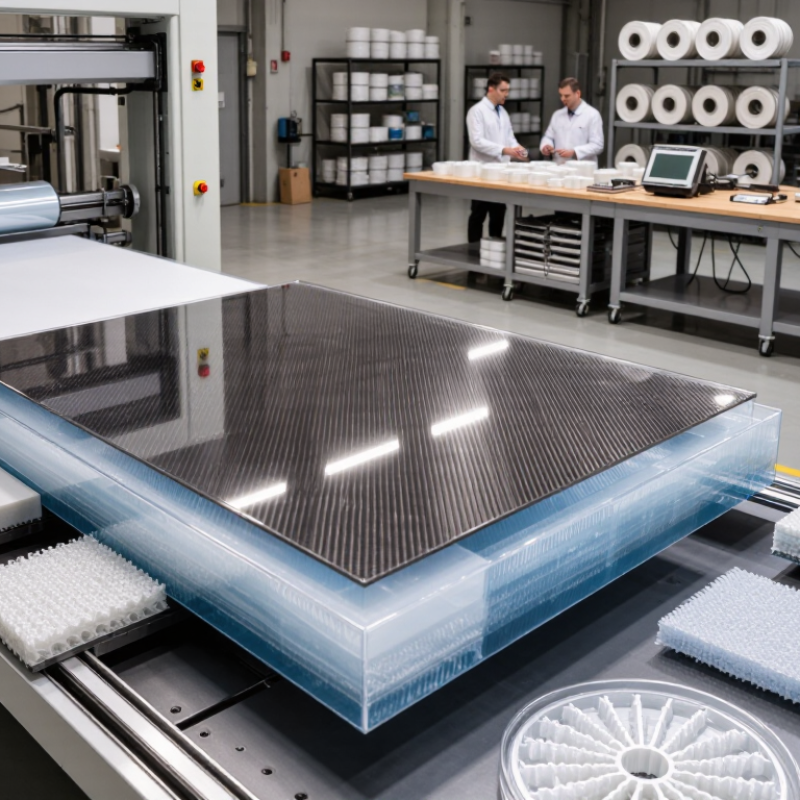
A composite part is an engineered component made from two or more distinct materials. One material reinforces the structure, while another binds and protects it. In many applications, continuous fibers carry loads, and a polymer matrix transfers stress between them. The result is not simply a mixture. It is a designed material system with directional performance.
Its properties depend on fiber type, orientation, volume fraction, resin, and manufacturing quality. A carbon-fiber panel, for example, may be stiff along its fiber direction but weaker across its thickness. The U.S. Department of Energy reports that reducing vehicle weight by 10% can improve fuel economy by approximately 6% to 8%. A 2024 market analysis from Grand View Research estimates that the global composites market exceeded 100 billion U.S. dollars in 2023. These figures show practical value, but they do not guarantee success. Voids, uneven curing, or poor bonding can quietly reduce performance. The definition sounds simple. Production is not.
Tips: Define the load path before selecting materials. Check fiber orientation, resin compatibility, cure temperature, and inspection requirements. Use data from ASTM or ISO test methods where possible. A lighter part is not automatically a better part. Engineers should question whether the process is repeatable, especially when hand lay-up introduces variation.
| Data Dimension | Definition or Typical Data | Why It Matters in a Composite Part |
|---|---|---|
| Composite part | A component made by combining two or more distinct materials that remain identifiable in the finished structure. | The combined materials provide properties that a single material may not achieve alone, such as high stiffness at relatively low weight. |
| Reinforcement | Continuous fibers, chopped fibers, fabrics, or other load-bearing elements. | Carries much of the mechanical load and strongly influences tensile strength, stiffness, and directional performance. |
| Matrix | A polymer, metal, or ceramic material that surrounds and supports the reinforcement. | Transfers loads between fibers, maintains the part shape, and protects the reinforcement from environmental damage. |
| Common reinforcement forms | Unidirectional tape, woven fabric, braided structures, chopped strands, and mats. | The form controls fiber alignment, drape, surface coverage, production speed, and the direction of strength. |
| Fiber orientation | Fibers may be aligned at 0°, 90°, or angled orientations such as ±45°. | Orientation determines how efficiently the part carries loads in different directions. A laminate with several angles can provide more balanced performance. |
| Fiber volume fraction | The percentage of the composite volume occupied by reinforcement. Many structural polymer composites use approximately 40%–65% fiber by volume, depending on the process and design. | Higher fiber content can improve stiffness and strength, but excessive content may make wet-out, consolidation, and quality control more difficult. |
| Layup | The planned sequence, orientation, and location of reinforcement layers in a laminate. | A carefully designed layup controls thickness, stiffness, strength, damage tolerance, and resistance to bending or twisting. |
| Mold or tool | A shaped surface or matched set of surfaces used to define the part geometry during forming and curing. | The tool determines dimensional accuracy, surface finish, repeatability, and the achievable production rate. |
| Wet-out or impregnation | The process of distributing matrix material throughout the reinforcement and removing areas that are not properly wetted. | Incomplete impregnation can create voids and weak areas, reducing strength and long-term durability. |
| Consolidation | The application of pressure, vacuum, rollers, or other methods to compact layers and reduce trapped air. | Good consolidation improves interlayer bonding, reduces void content, and helps achieve consistent thickness. |
| Curing or solidification | A chemical reaction or cooling stage that changes the matrix from a workable state into a solid structure. | The cure cycle affects final mechanical properties, dimensional stability, residual stress, and production time. |
| Vacuum bagging | A flexible sealed film is placed over the laminate, and air is removed to apply atmospheric pressure during processing. | It can improve consolidation and reduce trapped air without requiring a fully matched rigid mold. |
| Compression molding | A charge of reinforcement and matrix is placed in a heated mold and compressed until the part forms and cures. | It provides repeatable dimensions and is suitable for producing multiple parts with relatively short cycle times. |
| Resin transfer molding | Dry reinforcement is placed in a closed mold, and liquid resin is injected or drawn through the fibers before curing. | The process can produce complex shapes with controlled surfaces and more consistent resin distribution than many open-mold methods. |
| Filament winding | Resin-coated continuous fibers are wound around a rotating mandrel at controlled angles. | It is effective for cylindrical or rotational parts because fiber paths can be aligned with pressure and hoop loads. |
| Pultrusion | Continuous fibers are pulled through a resin bath and a heated forming die to create a constant cross-section. | It supports efficient continuous production of profiles such as rods, channels, beams, and flat sections. |
| Quality checks | Visual inspection, dimensional measurement, fiber and resin content checks, ultrasonic inspection, and mechanical testing. | Inspection helps identify delamination, porosity, dry areas, cracks, incorrect dimensions, and other defects before service. |
| Typical advantages | Low density, high specific strength, high specific stiffness, corrosion resistance, and design flexibility. | These advantages make composite parts useful where weight reduction, tailored performance, or resistance to harsh environments is important. |
| Typical limitations | Anisotropic behavior, sensitivity to manufacturing defects, more complex repair procedures, and challenges in recycling some thermoset systems. | Material selection and process control must be matched to the expected loads, temperature, moisture, impact, and service life. |


© Copyright 2025 | LittleFirefighter.com | All Rights Reserved | 1EZ Creative: Orange County Web Design