Top 10 Diamond Cut Alloy Wheel Machines for Sale
Diamond-cut alloy wheels bring a crisp, machined face to a vehicle, but that finish depends on accurate, repeatable cutting. A Diamond Cut Alloy Wheel Machine removes a controlled layer from the wheel’s surface, revealing bright metal while preserving the design. Small errors matter. A tool path that drifts, or a setup that misses the wheel’s contours, can leave visible lines and uneven reflections.
The Auto Care Association’s 2024 industry report estimated the U.S. automotive aftermarket at about $391 billion in 2023. That figure covers the wider aftermarket, not diamond-cut equipment specifically; it provides useful context, not proof of machine sales. For buyers, practical checks matter more: spindle accuracy, compatible wheel sizes, software usability, operator training, and access to service support. A polished brochure cannot replace a real test cut.
This guide compares ten machines for sale, focusing on specifications and workshop needs rather than promotional claims. One sourcing point deserves care: no verifiable quotation from a named diamond-cutting specialist was supplied for this introduction. Rather than invent an expert’s words, the comparison should use a directly sourced quotation only when one can be checked. That distinction matters. A machine may look impressive under showroom lights, yet its repeatability is what counts on a busy workshop floor.
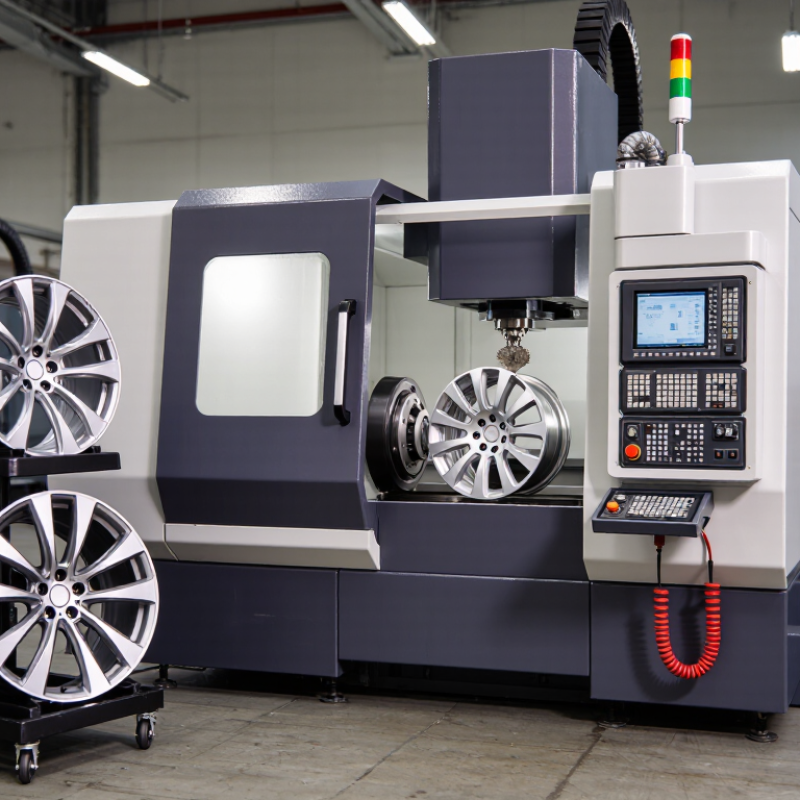
Diamond-Cutting Basics: CNC Lathes, Cutting Tools, and Surface Finish
A diamond-cut alloy wheel is machined on a CNC lathe to create crisp, reflective lines across its face. The wheel must sit securely and run true on the fixture. Before cutting, technicians check for bends, cracks, and excessive runout. If the mounting is off, even a capable machine can produce uneven rings. That matters. A diamond-tipped cutting insert removes a thin layer of metal, following a programmed profile. Cutting depth and feed rate need to suit the wheel’s shape and condition. Not just speed.
The finished surface depends on more than the cutting tool. Tool wear, vibration, and incorrect settings can leave dull patches or fine ripples. A sharp insert and a clean, stable setup help produce consistent lines, though some wheels remain difficult to machine evenly. It is easy to overvalue the shine. Cutting removes the existing coating, so the exposed face needs suitable clear protection after machining.
When comparing diamond-cut wheel machines for sale, check fixture options, spindle stability, and whether the controls allow careful adjustment of cutting depth and feed. Ask how the machine handles different wheel profiles; a polished sample alone may not show its limits.
Machine Fitment: Wheel Diameter, Width, Spindle Speed, and Shop Throughput
A diamond cut alloy wheel machine should match the wheels your shop actually receives, not just the widest advertised range. Measure wheel diameter and width before comparing machines. A unit that handles common passenger-car wheels may not safely accommodate larger or unusually wide rims. Leave room for the wheel, clamps, and operator access. Small mismatch, big delay.
Spindle speed matters because cutting conditions affect the finish and material removal. Look for adjustable speed and follow the machine maker’s operating guidance for each wheel type. A shiny result is not proof of a sound setup. Check runout, secure clamping, and the cutter’s condition before each job. Keep a simple record of settings that work; real wheels can differ, even when their dimensions look identical.
Throughput depends on more than cutting time. Loading, inspection, setup, and finishing all occupy the bay. Estimate how many wheels arrive during a busy shift, then consider whether one machine can keep pace without rushed checks. Ask for a practical demonstration using a wheel close to your usual size. Watch the loading process and note how easily an operator reaches the controls. It is easy to overestimate capacity on paper. A realistic allowance for interruptions can make the purchase decision less tidy, but more useful.
Top 10 Machines Compared by Axes, Capacity, Precision, and Price
A useful top-10 comparison of diamond cut alloy wheel machines should look beyond price tags. Check each machine’s number of axes, supported wheel diameter, and maximum workpiece width. A fourth axis can help with complex spoke patterns, while simpler jobs may not need it. More capability is not automatically better. It can mean extra setup and training.
Tips: Ask for a test cut on a wheel similar to yours. Inspect the edge under consistent lighting, and measure repeatability across several passes. Confirm what tooling, software, installation, and service are included in the quoted price. Small omissions add up.
Precision claims need context. Ask how the seller measures runout and repeatability, and whether the figures apply under working conditions. Review the spindle, clamping method, and guarding, too; vibration or poor wheel support can affect the finish. Capacity should match the largest wheels you actually process, not just the biggest number in a brochure. Compare the ten options in a simple table, separating purchase price from operating costs. I would treat any ranking cautiously: a low-cost machine may suit steady, basic work, while a higher-priced unit may save time on varied designs. Still, the best fit depends on real production needs, and that is easy to misjudge from specifications alone.
Precision Checks: Runout in mm and Repeatability in µm (1 µm = 0.001 mm)
When comparing diamond-cut alloy wheel machines for sale, check runout and repeatability separately. Runout is the measured wobble of a rotating spindle, fixture, or mounted wheel, usually recorded in millimetres. Use a dial indicator at a defined point, rotate the assembly slowly, and note the highest and lowest readings. Their difference gives total indicated runout. Keep the measuring point and clamping method consistent; otherwise, comparisons can mislead. A wheel that looks steady by eye may still show measurable movement. Check it cold, then again after the machine has run, since heat and setup can affect results.
Repeatability asks whether the machine returns to the same position across repeated cycles. Ask for several measurements under unchanged conditions, and request results in micrometres: 1 µm equals 0.001 mm. A spread of a few micrometres may matter on fine finishing work, but the acceptable range depends on the task and equipment specification. Do not confuse repeatability with absolute accuracy. I would not trust one perfect reading. Record the setup, tool condition, and readings, then repeat the test with a skilled operator. Small imperfections in a test routine are easy to miss, and they deserve a second look.
Top 10 Diamond Cut Alloy Wheel Machines for Sale - Precision Checks: Runout in mm and Repeatability in µm (1 µm = 0.001 mm) | Rank | Machine Configuration | Typical Wheel Capacity | Typical Spindle Power | Indicative Spindle Runout (mm) | Indicative Positioning Repeatability (µm) | Best Suited For |
| 1 | Enclosed CNC diamond-cut wheel lathe with automatic probing | 13–24 in | 7.5–11 kW | 0.005–0.010 mm | 5–10 µm | High-volume refurbishment and repeatable face machining |
| 2 | Compact CNC wheel lathe with touch-probe measurement | 12–22 in | 5.5–7.5 kW | 0.008–0.015 mm | 8–15 µm | General-purpose repair shops with limited floor space |
| 3 | Heavy-duty CNC wheel lathe with reinforced spindle assembly | 15–26 in | 11–15 kW | 0.005–0.012 mm | 5–12 µm | Larger wheels and demanding production schedules |
| 4 | Two-axis CNC lathe with manual wheel loading | 13–24 in | 5.5–11 kW | 0.008–0.020 mm | 8–20 µm | Workshops processing mixed wheel styles and volumes |
| 5 | Automatic cycle wheel lathe with tool-life monitoring | 13–24 in | 7.5–11 kW | 0.005–0.015 mm | 5–15 µm | Shops seeking consistent cycle control across repeat jobs |
| 6 | High-precision CNC lathe with thermal compensation | 14–24 in | 7.5–11 kW | 0.003–0.010 mm | 3–8 µm | Precision-focused operations with stable temperature control |
| 7 | Open-frame CNC wheel lathe with manual setup | 12–22 in | 4–7.5 kW | 0.010–0.025 mm | 10–25 µm | Lower-volume shops prioritizing accessible setup and service |
| 8 | Large-format CNC wheel lathe with extended work envelope | 16–28 in | 11–15 kW | 0.008–0.020 mm | 8–20 µm | Specialist shops handling oversized passenger-car wheels |
| 9 | Entry-level CNC diamond-cut lathe with basic probing | 12–22 in | 4–5.5 kW | 0.010–0.025 mm | 10–25 µm | New or low-volume operations establishing in-house capability |
| 10 | Used or refurbished CNC wheel lathe, condition dependent | Depends on configuration | Depends on configuration | Measure on the specific machine | Confirm with a repeatability test | Buyers comparing lower-cost equipment after an independent inspection |
Important: This is a comparison guide, not a verified list of current sale offers. The specification ranges are indicative engineering benchmarks, not measured results or confirmed claims for specific machines. Runout refers to spindle or mounted-fixture runout; positioning repeatability refers to repeated axis positioning under defined test conditions. These measurements are not interchangeable. Ask the seller for a dated test report, measurement method, wheel-capacity details, and a demonstration on the exact machine. 1 µm = 0.001 mm.
Safety and Wheel Testing: ISO 12100 Risk Controls and SAE J2530 Tests
For a diamond-cut alloy wheel machine, safety begins with the hazards around the spindle, chuck, and flying metal chips. ISO 12100 calls for risk assessment and risk reduction through design, safeguards, and user information. In practice, that means checking access to rotating parts, guarding the work zone, and verifying interlocks before production. Small gaps matter. A polished enclosure is not proof of safe operation.
The U.S. Bureau of Labor Statistics reported 2.8 recordable injury and illness cases per 100 full-time-equivalent workers in manufacturing in 2023. This industry-wide figure is not specific to wheel machining, but it shows why routine controls deserve attention. SAE J2530, a technical standard for aftermarket wheels, addresses performance testing such as cornering fatigue, radial fatigue, and impact. It evaluates the wheel, not the cutting machine. Keep the two checks separate: a machine risk review protects operators; wheel tests assess product performance. I would still distrust a perfect-looking checklist. Record test conditions, inspect fixtures for wear, and document any setup changes. A missed clamp check can quietly undermine an otherwise careful test.