
Buying a Door sign for international use involves more than choosing a color and uploading a logo. Global buyers must balance visibility, durability, accessibility, installation, and regional expectations. A sign that looks excellent online may appear too small in a dim office corridor. Its adhesive may also fail on textured walls or humid surfaces.
This guide presents seven practical buying tips for evaluating suppliers and products. It considers materials such as acrylic, aluminum, wood, and engraved plastic. It also examines letter contrast, tactile details, mounting methods, packaging, and sample approval. Experienced procurement teams usually request a physical sample before placing a large order. That small step can reveal rough edges, weak printing, or inaccurate colors.
Check the details closely.
Reliable suppliers should explain production tolerances, cleaning instructions, lead times, and quality inspections. Buyers should also confirm applicable building, accessibility, and fire-safety requirements with qualified local professionals. Requirements can differ between countries, building types, and public spaces. Never assume one design works everywhere.
Some decisions remain imperfect. The lowest price may create replacement costs later. A premium finish may exceed the project’s practical needs. Even a carefully reviewed Door sign can require changes after installation. These realities make clear specifications, documented approvals, and honest supplier communication essential. The following tips help global buyers reduce avoidable mistakes while selecting signs that remain readable, secure, and professional over time.
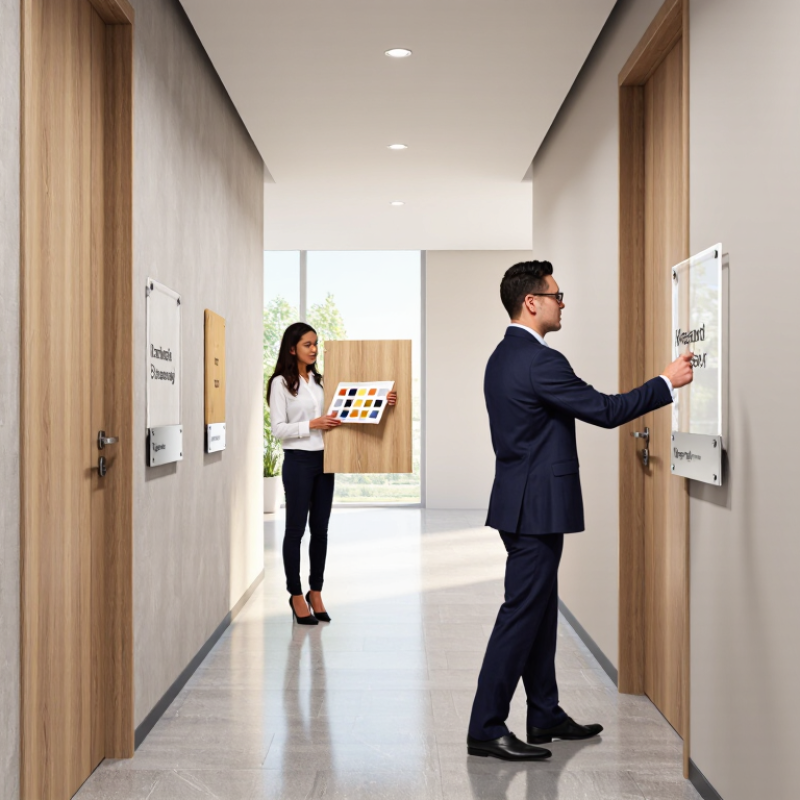
7 Door Sign Buying Tips for Global Buyers
Classify the sign by use before comparing materials or prices. Room signs need clear text, strong contrast, and easy cleaning. Directional signs need fast recognition from a distance. Safety signs may require specific symbols, colors, or wording. Outdoor signs need protection from rain, sunlight, and temperature changes. A polished finish alone does not make a sign suitable.
Traffic changes the buying decision. A quiet office may use lightweight signs with simple mounting. A busy hospital, school, or transport facility needs durable surfaces and secure fixtures. Check viewing distance, corridor width, lighting, and cleaning frequency. For crowded areas, avoid tiny lettering and reflective glare. Test a sample from several angles. It may look readable on a desk but fail across a hallway.
Local code requirements must guide the final specification. Requirements can cover accessibility, tactile lettering, Braille, contrast, mounting height, fire-rated materials, and language use. They vary by country, city, building type, and public access level. Ask a qualified local inspector or project professional to review the design. Supplier documents should confirm dimensions, materials, and test results. I once underestimated installation details; the sign met the visual brief but needed extra mounting work. That mistake was avoidable. Allow time for local review before placing a large order.
| No. | Buying Tip | Primary Use | Typical Traffic Level | Recommended Sign Specification | Relevant Code or Accessibility Check | Procurement Priority | Buyer Action |
|---|---|---|---|---|---|---|---|
| 1 | Define the door function first | Best for: Offices, classrooms, restrooms, laboratories, service rooms, and restricted areas. | Low to medium; usually used by employees, visitors, or scheduled occupants. | Select clear text such as “Meeting Room,” “Staff Only,” or “Electrical Room.” Use durable, non-glare materials for indoor locations and weather-resistant materials for exterior doors. | Confirm whether the door identifies a public facility, accessible room, emergency area, or hazardous space. Meaning and placement may be regulated locally. | High | Create a door schedule listing every room name, room number, access level, language, and installation location. |
| 2 | Classify traffic before choosing materials | Low traffic: Private offices and storage rooms. High traffic: Restrooms, schools, hospitals, transport facilities, and retail buildings. | Low: fewer than 25 daily contacts. Medium: approximately 25–100 daily contacts. High: more than 100 daily contacts or frequent cleaning. | For high-traffic areas, favor impact-resistant, moisture-resistant, scratch-resistant, and easy-to-clean surfaces. For low-traffic areas, standard rigid plastic, metal, or acrylic may be sufficient. | Check fire, hygiene, chemical-resistance, and cleanability requirements where signs are installed in healthcare, food-service, laboratory, or industrial environments. | High | Match the material warranty and maintenance requirements to the expected number of daily users and cleaning cycles. |
| 3 | Separate identification from directional signage | Door identification: Names, room numbers, functions, and access restrictions. Directional signage: Arrows, floor routes, exits, and destination guidance. | Medium to high, especially in complex buildings where visitors need information quickly. | Keep door signs concise. Use directional signs at decision points such as corridors, stairwells, elevators, and intersections rather than placing excessive information on the door. | Verify whether the building code requires separate exit, fire equipment, accessible route, or emergency-direction signs. Local authorities may prescribe symbols, colors, or wording. | High | Prepare two artwork groups: door-mounted identification signs and wall-mounted directional signs. |
| 4 | Check accessibility requirements early | Public buildings, workplaces, healthcare facilities, schools, hotels, transportation hubs, and other areas open to visitors. | Medium to high; signs must serve people with different visual, mobility, and reading needs. | Consider high contrast, readable sans-serif lettering, tactile characters, Grade 2 Braille where required, and a non-glare finish. In the United States, accessible signs are commonly reviewed against ADA Standards; other countries may use different rules. | Confirm local requirements for tactile characters, Braille, mounting height, sign location, contrast, pictograms, and clear floor space. ADA requirements do not automatically apply in every country. | High | Obtain approval from the local architect, accessibility consultant, or authority having jurisdiction before production. |
| 5 | Adapt language and symbols to the market | Multilingual offices, airports, hotels, campuses, hospitals, and buildings serving international visitors. | Medium to high; misunderstanding can increase queues, staff workload, and safety risks. | Use approved translations, consistent terminology, and internationally recognizable pictograms. Avoid relying only on color or unfamiliar abbreviations. | Check official-language requirements, local fire and safety symbols, right-to-left text needs, character support, and whether bilingual or trilingual signs are mandatory. | Medium | Have every translation reviewed by a qualified local speaker and use vector artwork that supports the required scripts. |
| 6 | Specify the installation environment | Interior doors, exterior entrances, wet rooms, coastal sites, industrial facilities, high-temperature areas, and locations exposed to sunlight. | Traffic may be low or high, but environmental exposure can determine service life. | Specify UV stability, corrosion resistance, moisture resistance, temperature range, adhesive performance, screw-fixing options, and cleanability. Exterior signs normally require more robust specifications than interior signs. | Review local requirements for fire performance, evacuation visibility, electrical-room labeling, chemical exposure, and fixing methods on fire-rated doors. | High | Record indoor or outdoor use, approximate temperature range, humidity, sunlight exposure, cleaning chemicals, and mounting surface for each sign type. |
| 7 | Verify mounting position and future changes | New construction, renovation projects, leased offices, hospitals, schools, and facilities where room assignments may change. | High traffic requires secure mounting; changing room functions require replaceable inserts or modular systems. | Select concealed fixings or tamper-resistant hardware in public areas. Use interchangeable inserts, slide-in panels, or replaceable overlays when room names and occupants may change. | Confirm door swing clearance, accessible approach zones, corridor width, fire-door restrictions, and required mounting heights under the applicable local code. | Medium | Approve a full-size placement sample before mass production and keep a spare-sign allowance for future replacements. |


© Copyright 2025 | LittleFirefighter.com | All Rights Reserved | 1EZ Creative: Orange County Web Design