
A Smart Air Pressure Gauge is more than a digital replacement for a traditional tire gauge. It combines a pressure sensor, electronic display, and sometimes Bluetooth connectivity. The device reads air pressure through a small valve connection, converts that measurement into digital data, and presents it in PSI, kPa, or bar. Some models also record readings, identify pressure changes, and send alerts to a phone. The result feels simple: connect, measure, understand.
John Nielsen, former managing director of Automotive Engineering and Repair at AAA, has emphasized, “Tire pressure is a safety issue, not merely a fuel-economy detail.” This principle explains why accurate measurement matters. A tire may look properly inflated while sitting several PSI below its recommended level. On a cold morning, the gauge might show 32 PSI. After a long drive, heat can raise the reading noticeably. That difference is real, not a device error.
The following guide explores how a Smart Air Pressure Gauge works inside and outside the tire. It examines sensors, calibration, display accuracy, wireless communication, and practical maintenance. It also considers battery life and weather effects. Small details matter. A loose valve connection can distort results. A weak battery may create uncertainty. Smart does not always mean perfect. Users still need the vehicle manufacturer’s recommended pressure and a careful measuring habit. Sometimes, the simplest manual check remains useful.
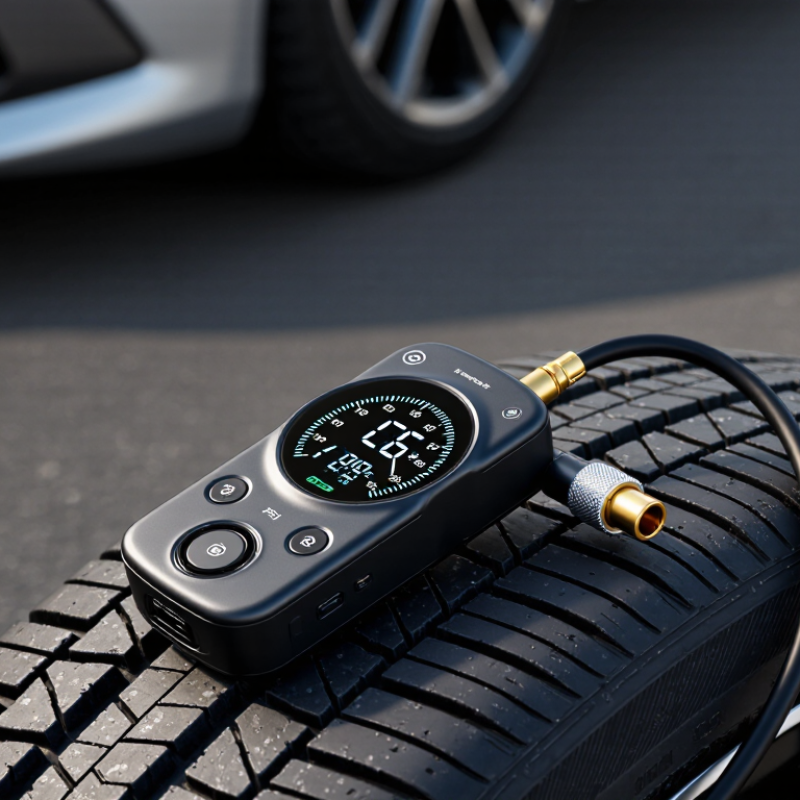
A smart air pressure gauge combines a pressure sensor, digital processor, display, battery, and air connection. Its main job is simple: measure pressure and present a clear reading. Inside, a diaphragm moves slightly when air enters the measuring chamber. The sensor converts this movement into an electrical signal. The processor then calculates pressure in units such as PSI, bar, or kPa.
Many models provide real-time readings, preset pressure targets, automatic shutoff, and low-pressure alerts. Some also record measurements or send data through a wireless connection. These functions can make routine checks faster, especially when working with tires, air tools, or compressed-air systems. However, “smart” does not mean perfect. Temperature changes, weak batteries, damaged seals, and an incorrectly fitted valve can affect accuracy. A gauge may display a precise number while the actual pressure is slightly different.
Tips: Keep the sensor opening clean and inspect the hose for cracks. Check the gauge against a trusted reference occasionally. Measure after the equipment rests, because heat can raise pressure temporarily. Do not press the connector at an angle. Small leaks matter. Calibration is also easy to postpone, and that is where confidence can become misleading. Record unusual readings instead of ignoring them, particularly when pressure changes repeatedly during the same inspection.
A smart air pressure gauge combines a pressure sensor, signal processor, and digital display. Many models also record readings or transmit them wirelessly. The sensor detects tiny changes in a diaphragm’s movement. Electronics convert that movement into a pressure value.
The most common sensing elements are piezoresistive and capacitive types. Temperature compensation matters because heat can shift the reading. So can vibration, leaks, and sensor drift. A clean number is not always a correct number. Regular calibration remains necessary.
Units can confuse users. The pascal is the SI unit, according to the BIPM SI Brochure. One kilopascal equals 1,000 pascals. One bar equals 100 kPa exactly, because the bar is defined as 100,000 pascals. This conversion is simple. The pressure reference is not. Gauge pressure measures pressure above surrounding air, while absolute pressure includes atmospheric pressure. At sea level, atmospheric pressure is roughly 101.3 kPa, but weather and altitude change it.
NIST Technical Note 1297 explains that measurement uncertainty must include repeatability, resolution, and calibration effects. A gauge showing 100.0 kPa may therefore have a wider real uncertainty. That detail is easy to miss. For reliable work, compare the gauge with a traceable reference under similar temperature and pressure conditions.
| Data Dimension | Typical or Standard Value | Technical Meaning | Practical Notes |
|---|---|---|---|
| Smart air pressure gauge | Digital pressure-measuring instrument | Uses an electronic pressure sensor, signal conditioning, a display, and often a microcontroller to calculate and show pressure. | Some models also record readings, switch units, transmit data, or provide high/low-pressure alerts. |
| Common sensing principle | Piezoresistive sensing | Pressure deflects a diaphragm and changes the resistance of strain-sensitive elements connected in a Wheatstone bridge. | The electrical output is converted into a pressure value by calibration data and digital processing. |
| Other sensor technologies | Capacitive, resonant, piezoelectric, or MEMS-based | Different technologies detect diaphragm displacement, frequency change, charge generation, or microscopic mechanical movement. | The suitable technology depends on pressure range, temperature, response speed, cost, and required stability. |
| Absolute pressure | Referenced to a near-vacuum | Absolute pressure includes atmospheric pressure and is expressed as pressure above an ideal vacuum. | Used when atmospheric changes must not affect the reference, such as in scientific and vacuum applications. |
| Gauge pressure | Referenced to local atmospheric pressure | Gauge pressure shows how much a system is above or below the surrounding atmosphere. | Most general-purpose air and tire gauges display gauge pressure unless marked otherwise. |
| Differential pressure | Pressure at port A minus pressure at port B | Measures the difference between two pressure points rather than pressure relative to a vacuum or atmosphere. | Useful for airflow, filter monitoring, ventilation systems, and flow measurement. |
| SI pressure unit | Pascal (Pa) | One pascal equals one newton per square metre: 1 Pa = 1 N/m². | Kilopascals (kPa) are commonly used because one kPa equals 1,000 Pa. |
| Bar standard | 1 bar = 100 kPa = 100,000 Pa | The bar is a metric pressure unit defined as exactly 100,000 pascals. | This is a convenient engineering conversion and is not exactly equal to standard atmospheric pressure. |
| Standard atmosphere | 1 atm = 101.325 kPa = 1.01325 bar | Standard atmospheric pressure is a defined reference based on average sea-level conditions. | Actual local atmospheric pressure varies with altitude and weather. |
| Pressure conversion | 1 psi ≈ 6.89476 kPa | Pounds per square inch is a customary pressure unit frequently used for tires and compressed-air equipment. | A gauge should clearly label the selected unit to prevent conversion errors. |
| Typical display units | kPa, bar, psi, and sometimes MPa | The same measured pressure can be displayed in different units using mathematical conversion. | Changing the display unit does not change the actual pressure. |
| Accuracy specification | Often stated as ±% of full scale | An accuracy of ±1% full scale on a 100 kPa range may permit an error of up to ±1 kPa. | Accuracy is not the same as resolution; a display with many digits is not automatically more accurate. |
| Resolution | Smallest displayed increment | For example, a 0.1 kPa resolution means the display changes in increments of 0.1 kPa. | Resolution describes readability, while accuracy describes closeness to the true value. |
| Repeatability | Consistency under repeated measurements | A repeatable gauge produces similar readings when the same pressure is applied under the same conditions. | High repeatability does not remove a consistent calibration offset. |
| Temperature effect | Sensor output may drift with temperature | Diaphragm materials and electronic components can respond differently as temperature changes. | Temperature compensation and allowing the gauge to stabilize can improve measurement quality. |
| Sampling and filtering | Periodic readings with digital averaging | The controller samples the sensor and may average or filter values to reduce vibration and short pressure spikes. | Heavy filtering produces a steadier display but can slow response to rapid pressure changes. |
| Zeroing function | Sets the current reference to zero | The gauge subtracts a measured offset from later readings, commonly for gauge-pressure measurement. | Zero only under the correct reference condition and do not zero a pressurized system unintentionally. |
| Data and alert features | Memory, peak hold, alarms, and wireless transfer | A smart gauge can store readings, identify maximum or minimum pressure, and notify users when limits are exceeded. | Connectivity features improve monitoring but do not replace correct calibration or safe pressure practices. |
| Basic measurement sequence | Pressure → diaphragm movement → electrical signal → calibrated digital value | The sensor converts mechanical pressure into an electrical response, which is digitized and processed for display. | Correct port connection, sealing, range selection, and calibration are essential for dependable results. |
A smart air pressure gauge measures pressure with a digital sensor, then sends readings wirelessly. The sensor detects changes inside a tire, pipe, tank, or pneumatic line. A small processor converts those changes into pressure values. Wireless protocols such as Bluetooth, Wi-Fi, or long-range radio carry the data to an app or control system. The app may display live pressure, record trends, or trigger an alert when readings leave safe limits.
In practical use, the connection is more valuable than the screen itself. A technician can stand beside a machine and review several gauges without opening every cabinet. A control system can also adjust valves or pause equipment after receiving abnormal data. This reduces delayed reactions, but it does not remove human responsibility. Wireless signals may weaken near metal walls, crowded networks, or industrial motors. Battery levels, calibration, and sensor placement also affect accuracy. It is not magic. A clear reading still needs sensible interpretation.
Tips: Keep the gauge calibrated against a trusted reference. Check the transmission range before installation. Use encrypted connections when the system supports them. Set alert limits based on operating conditions, not guesswork. Test failure responses regularly, because an app may show old data after a lost connection. I have found that simple status indicators help more than crowded dashboards. Some designs could still improve their warnings.
A smart air pressure gauge uses an electronic sensor to measure tire pressure continuously or at regular intervals. It converts pressure changes into digital signals and compares them with the vehicle’s recommended cold inflation pressure. Under FMVSS 138, the warning system must alert the driver when pressure falls to 25% or more below that placard value. This threshold is not a comfort setting. It is a safety benchmark for detecting significant underinflation.
The system may sample pressure while the vehicle is parked or moving. When one tire drops below the warning threshold, the control module identifies the change and activates a dashboard warning. A slow leak may begin with only a small pressure difference. Temperature can also shift readings, especially overnight. Cold morning checks matter.
Real-world checks still require care. I have seen drivers trust a warning light and ignore a tire that already looked soft. That is risky. A smart gauge supports inspection, but it does not replace it. Compare readings with a calibrated handheld gauge, inspect the valve area, and check for visible damage. Sensor accuracy can vary with calibration, battery condition, and temperature. One overlooked factor can distort the result. The vehicle’s placard pressure remains the correct reference, not the maximum pressure molded into the tire sidewall.
A smart air pressure gauge combines a pressure sensor, digital display, and control circuit in one instrument. Unlike a mechanical gauge, it can record readings, switch units, and send data wirelessly. Its convenience does not guarantee accuracy. Calibration controls reliability. During field checks, I compare the gauge with a traceable reference device at several pressure points. A zero reading matters too. Even a small offset can affect decisions when measuring low-pressure systems. Calibration should follow the manufacturer’s interval, but harsh use may require shorter intervals. That detail is often overlooked.
Battery condition also influences measurement reliability. Backlight use, wireless communication, and frequent sampling consume power quickly. A weak battery may cause unstable readings before the warning icon appears. Replace or recharge it before critical testing. Cold weather can reduce available battery capacity. I have seen a gauge perform normally indoors, then respond slowly beside a cold compressor. The result looked believable, but it needed verification. Small mistakes happen.
An IP rating describes protection from dust and water, not measurement accuracy. For example, IP65 generally means dust-tight protection and resistance to water jets. It does not mean safe immersion. IP67 allows temporary immersion under specified conditions, but damaged seals can change that protection. Check the battery cover, sensor port, and display housing for grit or cracks. Condensation can also enter after sudden temperature changes. Let the instrument stabilize before recording pressure. That simple pause improves confidence, although it is easy to skip during busy maintenance work.
© Copyright 2025 | LittleFirefighter.com | All Rights Reserved | 1EZ Creative: Orange County Web Design

Fusce ut ipsum tincidunt, porta nisl sollicitudin, vulputate nunc. Cras commodo leo ac nunc convallis ets efficitur.

12345 North Main Street,
New York, NY 555555
1.800.555.6789
sale@vibrotools.com
