
In 2026, Footwear Inspection is becoming more precise, data-driven, and practical. Buyers no longer judge shoes by appearance alone. They examine construction, comfort, safety, durability, and production consistency. A clean upper can still hide weak stitching, uneven bonding, or a poorly shaped insole.
The most common inspection types include visual inspection, measurement checks, material testing, and workmanship assessment. Visual inspectors look for loose threads, color differences, wrinkles, stains, and surface damage under controlled lighting. Measurement checks compare shoe length, width, heel height, and pair matching against approved specifications. Material testing examines leather, mesh, rubber, foam, and synthetic components for strength and flexibility. Small details matter.
Performance testing adds another layer. Inspectors may assess sole adhesion, flexing resistance, abrasion, water resistance, slip behavior, and repeated wear. Factory audits also review production records, calibration practices, worker training, and corrective actions. These records help connect a failed sample with its real production cause.
But inspection is not perfect. Sampling can miss a hidden defect. A laboratory result may not reflect every walking condition. Even experienced inspectors can disagree about minor finishing issues. That is why reliable footwear programs combine trained human judgment, documented procedures, suitable equipment, and independent verification. In practice, the strongest approach is not the most complicated one. It is the method that matches the product, customer, market, and actual risks. Manufacturers should review findings honestly and improve the process, rather than simply repair one defective pair.
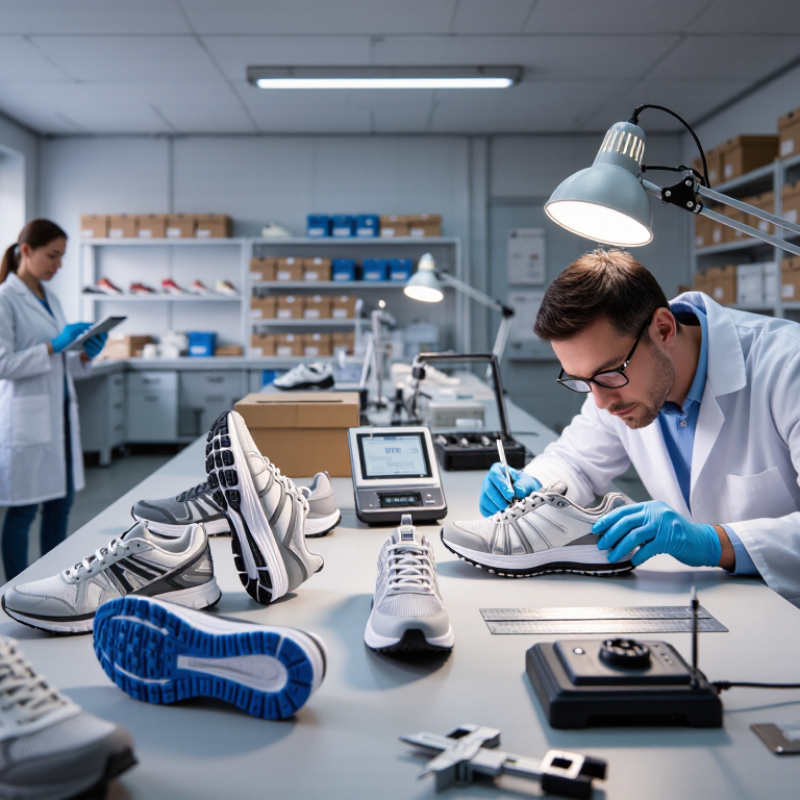
Visual and workmanship inspection remains a practical control point in footwear quality. The World Footwear Yearbook 2024 reports 23.9 billion pairs were produced globally in 2023. At that scale, small defects can multiply quickly. Inspectors examine uppers, linings, stitching, soles, and finishing under stable lighting. They check color consistency, panel alignment, wrinkles, loose threads, glue marks, and uneven edges. Left and right shoes must match closely.
Details matter most.
A trained inspector also verifies size labels, outsole patterns, logos, and packing accuracy. Measurement tools help confirm length, width, heel height, and symmetry. ISO 2859-1:2023 provides sampling principles for acceptance quality limits. However, sampling cannot replace good judgment. A carton may pass inspection while one uncomfortable shoe escapes detection. That assumption deserves challenge.
Workmanship reports should record defect location, severity, photographs, and corrective action. Major defects include open seams, visible bonding failure, or severe shape distortion. Minor defects may involve small scratches or slight thread irregularities. SATRA’s technical guidance emphasizes controlled testing and repeatable procedures across footwear production. Human fatigue remains a weakness, especially during long shifts. Rotating inspectors and using reference samples can reduce inconsistent decisions. Still, visual judgment is never perfectly objective. Skin tone, material texture, and factory lighting can change what inspectors notice. Clear criteria help, but experienced review is still essential.
| No. | Inspection Type | Primary Purpose | Key Checkpoints | Typical Inspection Method | Common Defects Detected | Priority |
|---|---|---|---|---|---|---|
| 1 | Overall Visual Inspection | To confirm that the finished footwear has an acceptable appearance and matches the approved reference sample. | Color, shape, symmetry, surface cleanliness, overall finishing, and visual consistency between the left and right shoes. | Inspect each selected pair under uniform lighting and compare it with approved samples, specifications, and color standards. | Visible stains, uneven color, misshapen toe boxes, surface marks, poor finishing, and noticeable asymmetry. | High |
| 2 | Workmanship Inspection | To evaluate the quality of assembly and the skill used to construct the footwear. | Stitching, bonding, edge treatment, material joining, panel alignment, seam allowance, and finishing consistency. | Visual examination supported by manual handling, seam measurement, and comparison with approved workmanship requirements. | Skipped stitches, loose threads, open seams, uneven stitching, excess adhesive, rough edges, and misaligned panels. | High |
| 3 | Upper and Material Inspection | To verify that the upper materials meet specified quality, appearance, and construction requirements. | Material type, thickness, texture, grain, perforations, wrinkles, cracks, color matching, and placement of decorative components. | Visual inspection, touch assessment, thickness measurement, and review of material identification against product specifications. | Leather or synthetic-material scars, inconsistent texture, wrong material, wrinkles, cracking, discoloration, and damaged panels. | High |
| 4 | Stitching and Seam Inspection | To ensure that stitched areas are secure, uniform, and correctly positioned. | Stitch density, stitch tension, back-tacking, seam strength appearance, thread color, thread trimming, and seam alignment. | Visual examination with a ruler or gauge; gently pull selected seams to identify loose construction without damaging the product. | Broken threads, skipped stitches, loose seams, excessive thread ends, puckering, uneven stitch lines, and incorrect thread color. | High |
| 5 | Sole Attachment Inspection | To verify that the outsole, midsole, and upper are securely and consistently joined. | Bonding line, adhesive coverage, sole alignment, heel seating, toe attachment, edge finishing, and gaps between components. | Visual inspection combined with manual flexing and controlled hand-peel checks where required by the testing specification. | Open bonding lines, exposed adhesive, sole separation, uneven attachment, misalignment, gaps, and excessive adhesive residue. | High |
| 6 | Component and Accessory Inspection | To confirm that all functional and decorative components are present, correctly positioned, and properly attached. | Laces, eyelets, buckles, zippers, hooks, logos or labels, insoles, heel counters, ornaments, and protective packaging components. | Count components, verify placement against drawings, and manually check attachment security and operation. | Missing components, incorrect parts, loose eyelets, damaged zippers, poorly attached ornaments, and incorrectly positioned labels. | Medium |
| 7 | Size, Shape, and Pair Matching Inspection | To ensure that the footwear conforms to the required size range and that each pair is correctly matched. | Length, width, fit-related dimensions, left-right matching, size marking, toe shape, heel height, and pair consistency. | Measure samples with approved footwear gauges or rulers and compare left and right shoes within the same pair. | Wrong size marking, mismatched pairs, dimensional variation, uneven heel height, distorted shape, and incorrect grading. | High |
| 8 | Interior and Comfort-Finish Inspection | To identify internal workmanship issues that may affect comfort, fit, or safe use. | Interior seams, lining, insole placement, exposed sharp edges, padding, rough surfaces, foreign objects, and moisture condition. | Visual and tactile inspection by opening the footwear, feeling internal surfaces, and checking selected areas for construction irregularities. | Loose lining, protruding nails or staples, rough seams, misplaced insoles, wrinkles, excess material, and foreign matter. | High |
| 9 | Color and Appearance Consistency Inspection | To confirm that the color and finish are consistent across components, pairs, and production lots. | Color shade, gloss or matte finish, print clarity, panel-to-panel matching, left-right consistency, and visible color transfer. | Inspection under controlled lighting using approved color references; instrumental color measurement may be used when specified. | Shade variation, color mismatch, fading, uneven coating, blurred prints, overspray, and color transfer between components. | Medium |
| 10 | Cleanliness and Final Finishing Inspection | To ensure that the product is clean, presentable, and ready for packing or shipment. | Dust, adhesive residue, fingerprints, loose threads, polishing marks, packaging cleanliness, tissue placement, and final presentation. | Final visual inspection after production finishing and before packing, using clean gloves where surface contamination is a concern. | Dirty surfaces, glue marks, loose threads, scuffing, incomplete polishing, damaged packaging, and missing protective materials. | Standard |
| 11 | Functional Workmanship Inspection | To verify that moving or adjustable footwear features operate correctly after assembly. | Zipper movement, lace eyelet security, buckle operation, hook-and-loop fastening, elastic recovery, and folding or flexing behavior. | Operate each applicable feature several times and perform controlled flexing or fitting checks according to the product specification. | Sticking zippers, broken fasteners, weak attachment points, poor elastic recovery, loose buckles, and fastening failure. | High |
| 12 | Packaging and Identification Inspection | To ensure that the inspected footwear is correctly identified, paired, protected, and packed for distribution. | Size labels, color and style information, carton markings, pair matching, quantity, tissue paper, inserts, and packaging integrity. | Compare product and packaging information with the packing list, approved artwork, and shipping requirements. | Wrong labels, mixed sizes, incorrect quantities, missing inserts, damaged boxes, and insufficient product protection. | Medium |


© Copyright 2025 | LittleFirefighter.com | All Rights Reserved | 1EZ Creative: Orange County Web Design