
In 2026, Temp And Humidity Monitor technology will serve homes, warehouses, laboratories, museums, farms, and data centers. The best choice will depend on accuracy, response time, connectivity, and operating conditions. A small Bluetooth sensor may protect medicines in a clinic refrigerator. A wired industrial monitor may protect servers from condensation and costly downtime. Different environments demand different designs.
Lord Kelvin, a pioneer in precision measurement, stated, “If you cannot measure it, you cannot improve it.” His words remain highly relevant to modern environmental monitoring. However, measurement is never perfectly simple. Sensor drift, poor placement, dust, airflow, and changing battery voltage can affect results. I have seen a monitor display stable humidity beside an open loading door, where readings changed within minutes. The device was not necessarily defective. Its position was wrong.
This guide examines the leading Temp And Humidity Monitor types expected in 2026. These include standalone digital monitors, wireless IoT sensors, data-logging devices, industrial transmitters, smart home units, and specialized systems for cold-chain storage. Each type offers practical strengths and uncomfortable limitations. Some provide excellent historical data but require software subscriptions. Others are affordable but lack calibration records. Accuracy claims also deserve careful review. A low-cost screen showing two decimal places does not automatically mean laboratory-grade performance.
Reliable selection requires more than comparing product prices. Users should examine calibration methods, alarm functions, sensor durability, communication range, data security, and maintenance needs. The “best” monitor may still fail when ignored. That is the part many buying guides miss.
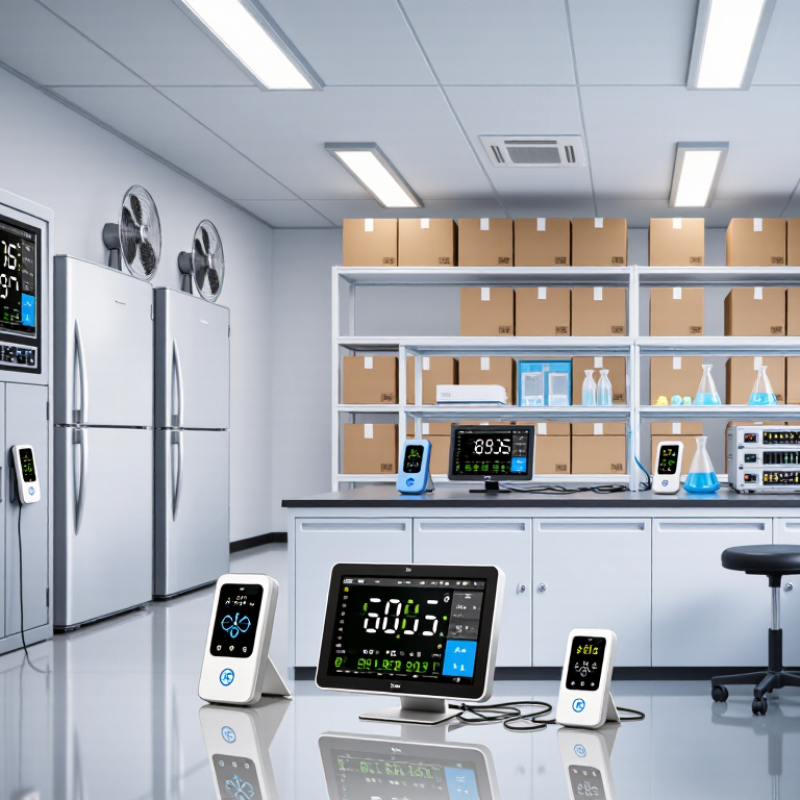
What Are the 2026 Top Temp And Humidity Monitor Types?
The best 2026 monitors should match the measurement task, not marketing labels. Fixed transmitters suit warehouses and laboratories. Wireless data loggers fit rooms, cabinets, and transport cases. Handheld probes help technicians verify readings near shelves, vents, and doors. Each type needs a clear accuracy target: ±0.5°C for temperature and ±5% RH for relative humidity, using ISO 7726 as a practical reference.
These limits matter during real inspections. A sensor showing 22.0°C and 50% RH may still be misleading if its calibration drift is ignored. NIST Technical Note 1297 recommends reporting measurement uncertainty with a coverage factor of k=2, commonly representing about 95% coverage. Therefore, a dependable monitor should provide calibration records, resolution below the target tolerance, and visible alarm history. Small details matter.
The World Meteorological Organization’s Guide to Instruments and Methods of Observation, WMO-No. 8, also stresses traceability, sensor exposure, and uncertainty evaluation. Poor placement can defeat an accurate sensor. A probe beside a cooling outlet may read 0.8°C lower than the room average. I have seen this mistake repeated. Operators should compare readings at several heights and locations, then document the adjustment. The uncomfortable truth is simple: a ±0.5°C specification means little without calibration, stable placement, and regular review.
Temperature and humidity monitoring is becoming more connected and data-driven. A 2024 environmental monitoring market analysis projects steady growth through 2030, driven by food storage, healthcare, laboratories, and buildings. The best monitor type depends on distance, response time, and network reliability.
Standalone monitors remain practical for rooms, cabinets, and small storage areas. They show readings immediately and usually need little setup. However, they cannot provide remote alerts.
Wi-Fi monitors offer live dashboards and automatic notifications. They suit offices and facilities with stable internet coverage. Their weakness is clear: network outages can interrupt reporting. Small gaps matter.
Bluetooth monitors consume little power and work well for short-range checks. A technician can collect readings while walking through several rooms. The 2024 Bluetooth Market Update reports continuing growth in connected sensor deployments, especially for asset tracking and environmental data.
LoRaWAN monitors cover larger sites with low power use. Industry reports commonly identify long battery life and wide-area coverage as major advantages. They fit farms, warehouses, and distributed facilities.
Yet, installation planning is harder. Signal performance may vary around concrete walls and metal shelving.
In practice, mixed systems often perform better than one universal choice. A standalone unit can verify a critical location locally. A wireless device can provide remote visibility. I would not trust a single sensor forever; calibration drift, blocked signals, and dead batteries remain easy to overlook. Regular comparison against a calibrated reference is still essential.
What Are the 2026 Top Temp And Humidity Monitor Types?
For 2026, the strongest temperature and humidity monitor types are standalone data loggers, wireless sensor nodes, and probe-based systems. The right choice depends on location, response time, and audit requirements. A logger with 0.1°C resolution can display small changes, but resolution is not accuracy. NIST measurement guidance separates resolution, accuracy, and measurement uncertainty. That distinction matters when a screen shows 21.4°C but the actual value may vary more.
Short sampling intervals reveal real conditions. One-minute sampling can capture a brief door opening, a cold-air burst, or a humidity spike near a loading area. The World Meteorological Organization reported that 2023 reached about 1.45°C above the 1850–1900 average. Small changes now deserve closer attention, especially in storage rooms and controlled workspaces. Still, one-minute logging creates larger files and may reduce battery life. More data is not automatically better.
Standalone units suit simple inspections and temporary surveys. Wireless monitors help teams view multiple rooms, but signal loss needs testing. Probe-based loggers perform better when the sensor must sit inside a cabinet, duct, or insulated container. I prefer 0.1°C resolution and one-minute sampling for risk-sensitive areas, then adjust after reviewing actual trends. That choice can be excessive for stable offices. It is also easy to confuse attractive graphs with reliable evidence. Calibration records, sensor placement, and documented review remain essential, as emphasized by ISO 7726 measurement principles.
| Monitor Type | Typical Temperature Resolution | Typical Temperature Accuracy | Typical RH Resolution | Typical RH Accuracy | 1-Minute Sampling | Typical Memory Capacity | Connectivity and Power | Best-Fit Applications | Overall Suitability |
|---|---|---|---|---|---|---|---|---|---|
| Standalone USB Data Logger | 0.1°C is common | About ±0.3°C to ±0.5°C from 0°C to 40°C | Usually 0.1% RH | About ±2% RH to ±3% RH at moderate humidity | Yes | Approximately 10,000 to 100,000 readings | USB download; replaceable or built-in battery; usually offline operation | Storage rooms, laboratories, transport checks, offices, archives and routine compliance records | Excellent for low-cost periodic monitoring |
| LCD Thermo-Hygrometer Logger | 0.1°C is common | About ±0.3°C to ±0.6°C | Usually 1% RH or 0.1% RH | About ±3% RH to ±5% RH | Yes, on many models | Approximately 2,000 to 32,000 readings | Built-in display; USB or button download on selected models; battery powered | Classrooms, museums, warehouses, greenhouses and areas requiring local visual checks | Very good for visible on-site readings |
| Wireless Bluetooth Logger | 0.1°C is common | About ±0.2°C to ±0.5°C | Usually 0.1% RH | About ±2% RH to ±3% RH | Yes | Approximately 8,000 to 50,000 readings | Mobile-app access; Bluetooth Low Energy; coin-cell or replaceable battery | Retail displays, small warehouses, refrigerators, cabinets and short-range inspections | Excellent when a phone-based workflow is sufficient |
| Wi-Fi or Cellular IoT Sensor | 0.1°C is common | About ±0.2°C to ±0.5°C | Usually 0.1% RH | About ±2% RH to ±3% RH | Yes | Cloud storage; local buffering commonly ranges from several days to several months | Remote dashboard, alerts and APIs; mains power or long-life battery options | Cold-chain monitoring, server rooms, production areas, distributed facilities and unattended sites | Best for real-time alerts and remote visibility |
| Industrial Network Temperature/RH Sensor | 0.1°C is common | About ±0.2°C to ±0.4°C after calibration | Usually 0.1% RH | About ±1.5% RH to ±3% RH | Yes | Often depends on the connected PLC, gateway or historian | Wired Ethernet, RS-485, Modbus or 4–20 mA; typically powered continuously | HVAC control, cleanrooms, manufacturing, building automation and process monitoring | Best for integration and continuous operation |
| High-Accuracy Laboratory Logger | 0.01°C to 0.1°C | About ±0.05°C to ±0.2°C, depending on the probe and calibration | Usually 0.1% RH | About ±1% RH to ±2% RH with a suitable probe | Yes | Approximately 10,000 to more than 1,000,000 readings | USB, Ethernet or dedicated software; external probes; mains or rechargeable battery | Calibration laboratories, validation studies, pharmaceutical areas and research environments | Best when measurement uncertainty matters most |
| Multi-Channel Probe Logger | 0.1°C is common | About ±0.2°C to ±0.5°C, depending on probe type | Usually 0.1% RH | About ±2% RH to ±3% RH with digital RH probes | Yes | Approximately 50,000 to 500,000 total readings | Multiple external probes; USB, Ethernet or wireless gateway options | Mapping studies, transport validation, incubators, cold rooms and multi-zone testing | Best for comparing several locations at once |
Choosing a temperature and humidity monitor starts with the HVAC task, not the device’s screen. ASHRAE Standard 55 commonly guides indoor comfort within a 30–60% relative humidity range. That range is practical, but it is not a universal guarantee of comfort. Occupancy, air movement, clothing, and radiant temperature can change the experience.
Wall-mounted monitors suit offices, classrooms, and living areas needing quick visual checks.
Data-logging models help facility teams identify overnight humidity spikes or cooling failures.
Wireless sensors work well in larger buildings, especially where wiring is difficult.
Probe-based instruments offer better access inside ducts, storage rooms, or near equipment.
Each type has limits. A wireless signal can drop. A small screen can hide slow changes.
Place the sensor away from sunlight, vents, doors, and personal heaters. A monitor beside a supply grille may report unusually dry air. That reading could mislead an HVAC adjustment.
Use several sensors when rooms have different exposures. Compare readings during occupied and unoccupied periods. Calibration also matters; even reliable instruments drift over time.
I have seen two nearby devices disagree enough to delay a sensible decision. That was not dramatic, but it exposed weak maintenance habits.
For comfort-focused HVAC control, choose a monitor that records trends, supports verification, and matches the room’s risk. Fast readings help operators react. Logged readings help them understand why. Check the actual environment, not only the number.
What Are the 2026 Top Temp And Humidity Monitor Types?
For 2026, industrial temperature and humidity monitors are becoming more specialized. Common types include standalone data loggers, wireless sensors, fixed transmitters, and remote probe systems. Choose models with IP65 protection for dusty production areas, warehouses, and maintenance rooms. IP65 means protection against dust and low-pressure water jets. It does not mean safe immersion.
A NIST-traceable calibration record adds valuable measurement confidence. It should show the tested points, reference equipment, uncertainty, and calibration date. Traceability requires an unbroken comparison chain to recognized national standards. It is not the same as claiming official certification from NIST. In practice, verify calibration at conditions close to your process, such as 20°C and 50% relative humidity. A sensor can look precise but still drift over time. This detail is often overlooked.
Tips: Check the IP rating before installation. Confirm the operating range, probe response time, and alarm settings. Keep calibration records with serial numbers and location history. Replace damaged seals quickly. I have seen reliable units fail because the cable gland was loose. Also, avoid placing sensors beside doors, heaters, or fresh-air vents. Readings may be technically correct but operationally misleading. A six-month verification schedule may work well, though harsh environments can require shorter intervals.
© Copyright 2025 | LittleFirefighter.com | All Rights Reserved | 1EZ Creative: Orange County Web Design

Fusce ut ipsum tincidunt, porta nisl sollicitudin, vulputate nunc. Cras commodo leo ac nunc convallis ets efficitur.

12345 North Main Street,
New York, NY 555555
1.800.555.6789
sale@vibrotools.com
