
Global construction is entering a period of stricter performance, sustainability, and supply-chain expectations. artificialstone is gaining attention because it can deliver consistent dimensions, controlled finishes, and practical design flexibility across different regions. Grand View Research estimates that the global engineered stone market was valued at approximately USD 29.9 billion in 2023, with continued growth expected through 2030. Market terminology differs, however. Engineered stone, sintered stone, and other artificialstone products should not be treated as identical materials.
Performance matters on real projects. A large hotel lobby may require hundreds of matching panels, while a residential tower may need repeated countertop sizes across several floors. Factory-controlled production can reduce color variation and simplify replacement planning. Yet quality is not automatic. Buyers should review water absorption, flexural strength, abrasion resistance, fire performance, and installation requirements through recognized testing procedures.
Sustainability also deserves careful examination. The 2023 Global Status Report for Buildings and Construction, published by UNEP, states that buildings and construction consumed 32% of global energy and produced 34% of global CO2 emissions in 2022. Artificialstone cannot solve this challenge alone. Its environmental value depends on recycled content, manufacturing energy, transport distance, service life, and end-of-life options. Environmental Product Declarations can support more reliable comparisons. They are useful evidence.
The practical lesson is simple. Consistency helps. Still, architects and contractors should not select artificialstone from catalog images alone. Samples, test reports, installation trials, and local technical advice remain essential. Some assumptions will fail on site. That is worth admitting. A material becomes globally suitable only when design ambition, verified performance, and responsible procurement work together.
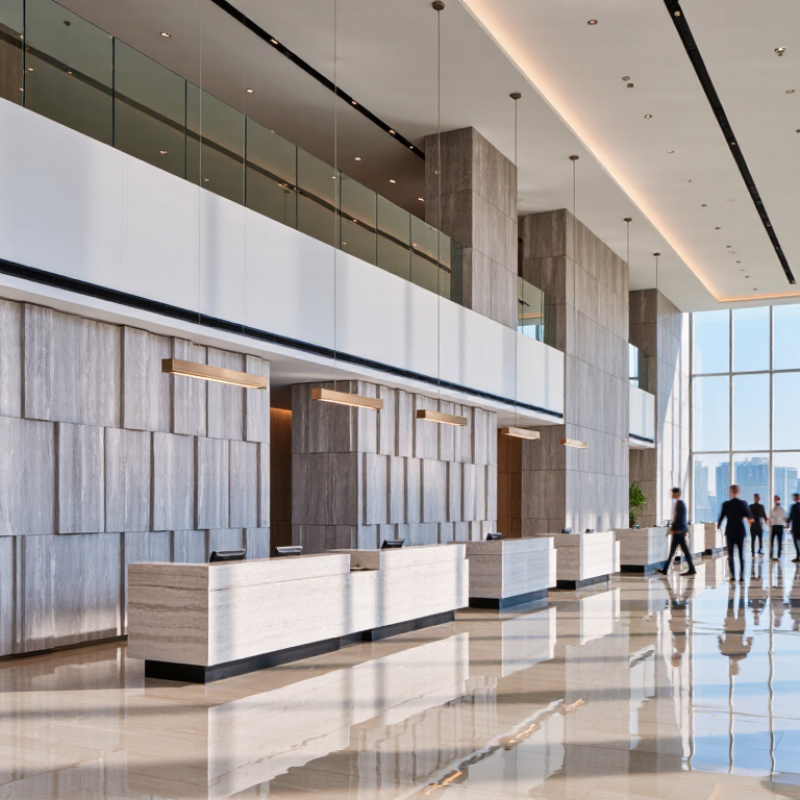
Engineered quartz is not simply crushed stone. Most slabs contain approximately 90–93% natural quartz, combined with resin, pigments, and performance additives. This high mineral content supports a dense, consistent surface for kitchens, hotels, offices, and public interiors. Safe Work Australia’s national guidance reports that engineered stone can contain up to 95% crystalline silica. The U.S. Geological Survey’s Mineral Commodity Summaries 2024 also recorded about 110 million metric tons of industrial sand and gravel production in the United States during 2023. These figures show the scale of mineral-based manufacturing, but they do not guarantee quality. Formulation and fabrication still matter.
Tips: Request a current technical data sheet. Confirm quartz content, water absorption, thickness tolerance, and heat limits. Ask whether the fabricator uses wet cutting or local dust extraction. Small errors matter. A perfect-looking sample can mislead when lighting, batch variation, or edge treatment changes the final appearance.
For global projects, engineered quartz offers repeatable patterns and easier specification across different locations. Designers can match surfaces between floors, counters, and reception areas with fewer natural color surprises. Experienced contractors still inspect every delivery for cracks, warping, and shade differences. The material is hard, but it is not indestructible. Unsupported overhangs, sudden heat, and poor joints may cause failures. Project teams should compare the manufacturer’s test results with regional standards and installation conditions. One assumption remains risky: higher quartz content does not automatically mean better performance.
Why Choose Artificial Stone for Global Projects?
Artificial stone is often selected for global projects because it combines visual consistency with dependable surface performance. Its Mohs hardness can approach 7, helping resist scratches from grit, tools, and daily traffic. This matters in hotel lobbies, airport counters, and busy retail spaces. Still, hardness is not the same as toughness. A sharp impact can chip an edge, especially around sinks or narrow corners.
Low water absorption offers another practical advantage. When moisture enters slowly, stains and freeze-thaw damage become less likely. A coffee spill on a properly finished surface can usually be cleaned before it leaves a mark. However, “low” does not mean zero. Installers should seal joints carefully and follow the material’s technical data. Project teams should also request absorption results from recognized testing laboratories, not rely only on sales descriptions.
Tips: Inspect sample edges before approval. Test the proposed cleaner on a hidden area. Keep spare pieces for future repairs. We often focus on hardness and overlook installation quality. That can be a costly mistake. Climate, transport conditions, and cleaning habits also affect long-term results. A near-7 Mohs rating is valuable, but it cannot replace correct support, careful handling, and realistic maintenance planning.
| Material Category | Typical Composition | Mohs Hardness | Water Absorption by Mass | Scratch Resistance | Stain and Moisture Behavior | Typical Maintenance | Suitability for Global Projects |
|---|---|---|---|---|---|---|---|
| Engineered Quartz Stone | Crushed quartz aggregates with polymer binders and pigments | Approximately 6–7 | Typically below 0.5% | High; resistant to ordinary household scratching | Low porosity helps limit liquid penetration and staining | Routine cleaning; sealing is generally not required | Strong choice for interior kitchens, hospitality, offices, and residential projects |
| Porcelain or Sintered Stone | Refined mineral clays and feldspathic materials fired at high temperature | Approximately 6–7 | Generally 0.5% or lower | Very high; suitable for demanding surface applications | Very low absorption; good resistance to moisture and many stains | Low maintenance; cleaning with compatible products | Well suited to floors, façades, wet areas, commercial interiors, and exterior applications |
| Granite | Natural igneous rock containing quartz, feldspar, and other minerals | Approximately 6–7 | Approximately 0.1–0.5% | High, but varies by mineral composition | Usually low absorption; unsealed areas may absorb liquids | Periodic sealing may be recommended depending on porosity and use | Suitable for interior and selected exterior architectural applications |
| Marble | Natural metamorphic rock primarily composed of calcite or dolomite | Approximately 3–5 | Approximately 0.1–2.0% | Moderate to low; more vulnerable to scratching and abrasion | May stain and can react with acidic substances | Regular sealing and careful cleaning are commonly required | Best for decorative interiors and applications where patina is acceptable |
| Limestone | Natural sedimentary rock primarily composed of calcium carbonate | Approximately 3–4 | Approximately 0.3–2.0% or higher, depending on grade | Low to moderate | More porous and sensitive to acidic liquids than dense stone categories | Frequent cleaning and periodic sealing may be needed | Suitable when a natural appearance is prioritized over maximum hardness |
Artificial stone can support demanding global projects, but safety claims need measurable evidence. ASTM is not one single approval; it is a family of technical methods. The correct method depends on use, exposure, and design. Countertops, façades, floors, and wet areas require different evaluations. A responsible supplier should provide current laboratory reports, sample identification, test conditions, and production-batch details.
EN 14617 is especially relevant to agglomerated stone products. Its test methods examine properties such as water absorption, flexural strength, abrasion resistance, and resistance to temperature changes. These results help specifiers judge cracking, staining, and surface wear in real installations.
A polished slab may look flawless under showroom lighting. Site conditions are less forgiving. Poor support, incorrect joints, or sudden temperature changes can still cause failure.
ISO 22196 evaluates antibacterial activity on treated, non-porous surfaces under controlled laboratory conditions. It does not prove that a room remains hygienic after installation. Cleaning routines, damaged finishes, moisture, and user behavior still influence performance.
ASTM and EN results should also be read with installation guidance and local project requirements. I have found that reports sometimes appear impressive but omit sample age or preparation details. That gap deserves questions.
Why Choose Artificial Stone for Global Projects?
Environmental Product Declarations, or EPDs, give project teams measurable carbon information. They report climate impacts, often in kilograms of CO2e per square metre. This makes material comparisons more practical across international projects. A verified EPD usually follows product category rules and life-cycle assessment standards. It may cover raw materials, manufacturing, transport, installation, use, and disposal.
The declared unit matters. A 20-millimetre slab should not be compared casually with a thinner product. Review the same thickness, application, and life-cycle modules. Manufacturing can include electricity, heat, resin, cement, pigments, and water use. Transport also changes the result. A factory shipment across an ocean may add more emissions than a regional delivery. Small details matter.
EPDs are useful, but they are not perfect. Some reports cover only production stages, such as A1 to A3. Others include construction and end-of-life scenarios. A lower carbon figure does not automatically prove better overall sustainability. Durability, maintenance, repair, recycled content, and cutting waste deserve attention. Project teams should request third-party verification and check the assessment date. Data can become outdated. Comparing several declarations is wiser than trusting one attractive number. The process takes time. That effort improves procurement decisions and makes carbon discussions more transparent.
Artificial stone can support global projects when appearance, durability, and documented compliance must work together. Yet material selection should begin with local requirements, not a showroom sample. Building codes may regulate fire performance, slip resistance, water absorption, hygiene, and structural use. These rules differ between countries and sometimes between cities.
A project team should request current test reports for the intended product and application. Verify that the reports match local standards, thickness, finish, and installation method. A laboratory result from one region may not satisfy an authority elsewhere. Check twice. Designers should also confirm indoor air quality requirements, adhesive emissions, and maintenance chemicals. In high-traffic areas, a small mistake in surface texture can create cleaning problems or safety concerns.
LEED criteria require careful documentation rather than broad environmental claims. Useful records may include an environmental product declaration, material ingredient information, recycled content data, and responsible manufacturing evidence. Artificial stone does not automatically earn credits. Its contribution depends on the project’s selected rating system and documented calculations. This is where experience matters: early coordination with architects, contractors, suppliers, and certification consultants prevents missing paperwork.
Real projects are rarely perfect. Product substitutions happen, and local interpretations can change during review. Therefore, teams should keep alternative compliance files and approve samples before installation. A clearly labeled sample wall can reveal color variation, joint visibility, and edge behavior under actual lighting. That practical check often exposes issues that digital drawings miss.
© Copyright 2025 | LittleFirefighter.com | All Rights Reserved | 1EZ Creative: Orange County Web Design

Fusce ut ipsum tincidunt, porta nisl sollicitudin, vulputate nunc. Cras commodo leo ac nunc convallis ets efficitur.

12345 North Main Street,
New York, NY 555555
1.800.555.6789
sale@vibrotools.com
